Sunday, August 31, 2014

Cordyceps Fungi: Bringers of Death, Givers of Life

Cordyceps sp. growing
from a lepidopteran
Today, I'm going to stretch your parasitophilia into a realm it has seldom explored. Today, we will look at a genus full of fungal parasites! First and foremost, if you don't know much about fungi, especially parasitic fungi, you should take some time to read up on them because they are really fascinating organisms. Like something straight out of science fiction, parasitic fungi are capable of everything from mind control to mummification. Such feats are unimaginable to the non-mycophiliac, but don't worry...I'll convert you! ;)

For this blogpost, we will look specifically at one of my favorite genera of parasitic fungi, the genus Cordyceps. The name for this genus comes Latin root words meaning "club" and "head", which relate to the characteristic shape of the fungi's fruiting bodies (i.e. "mushrooms"). Although Cordyceps spp. can be found in lots of places, the majority of species are described from Asia as the fungi prefer humid environments like tropical forests. There are approximately 400 species within this genus that can be found all over the world. All of these species (as far as I know) are parasitic. Most species parasitize insects or other arthropods, but some feed on other fungi. These fungi, like all fungi, produce mycelia (mats of fungal structures called "hyphae", which are kind of like super-awesome roots...they are used for nutrition absorption and help to anchor the fungi), however, unlike other fungi the mycelia from these fungi invade and eventually replace host tissues. The replacement of the host tissues with Cordyceps mycelia effectively mummifies the host and feeds the fungus in the process so that it can produce fruiting bodies, which will then produce reproductive spores by the thousands.

Look! A photo of a Cordyceps sp. taken at UNL!

Paras and Parasect
Cordyceps fungi have gained pop culture popularity for their creepiness. Even the gaming industry has picked up on how sci-fi-esque these little guys can be. For example, think back to your childhood and consider the Pokemon character, Paras. Paras starts as this crab-like creature with two mushrooms on its back. It evolves into Parasect once it reaches level 24. At this point, the fungus takes over the arthropod and the animal's eyes become milky-white in submission. The parasitic fungus induces the animals to live in caves and other dark, moist environments so that the fungus can grow. Swarms of Parasects can devour trees for nutrients. These have GOT to be inspired by Cordyceps, though I'm not aware of any directly-stated connections. Some games are less subtle; part of the plotline in the video game The Last of Us centered around a mutated strain of Cordyceps that turned people into zombie-like creatures. (Sounds right up my alley, huh?) Additionally, these fungi have made their way into some amazing artwork.

Poster from The Last of Us
featuring mutated Cordyceps.

A piece from DeviantArt
featuring a Cordyceps-like fungus.
Getting back to reality (oh, there goes gravity), a wide range of Asian cultures have utilized these kinds of fungi for traditional medicines. These have been used as aphrodisiacs, treatments for kidney and lung issues, and for revitalizing the fatigued elderly. Scientific researchers have even identified active compounds from these fungi that have pharmocological potential for treating cancer, liver disease, depression, and diabetes. (That's right, these things have hypoglycemic effects too...who knew?) In fact, a paper came out this past April that was titled: "Extract of Cordyceps militaris inhibits angiogenesis and suppresses tumor growth of human malignant melanoma cells". To translate for those of you struggling with the terminology, angiogenesis is the formation of blood vessels, which is necessary for tumor formation. This paper described how using an extract from the fungus not only slowed down angiogenesis, it also induced apoptosis (programmed cell death) in malignant melanoma cells (the bad, quickly-growing kind of melanoma). This study suggested the potential use of this fungus in the treatment of solid, cancerous tumors for its potent effectiveness. Aside from this, there have been a number of other studies looking to various Cordyceps species for their anti-cancer properties, but why stop there? It turns out that members of this genus also have anti-inflammatory properties, antioxidants, anti-fibrotic bioactivity, and even anti-trypanosomal activities! How awesome is that?!?!

The Moral of the Story
As most things in nature, Cordyceps has two sides...that of the villain and that of the hero. Their excitedly terrifying capabilities to suck their hosts dry to the point of becoming mummified cases of their former selves makes them the perfect organisms for science fiction stories. Their medicinal properties bring the potential for life and a sense of hope to those suffering from a wide variety of illnesses. Yes, the Cordyceps fungi exist as the duality of life and death, hope and despair, love and fear. It's a group of parasitic fungi worthy of reverence and deserving of our admiration.

Also, here's a link to a sweet Cordyceps video clip from the BBC narrated by none other than David Attenborough. Enjoy! :)
I'm not going to tell him....

Sunday, August 24, 2014

Ticks That Make You Sick: Ixodida-Induced Vegetarianism

Greetings fellow parasitophiles! I'm sorry that I've been out of the loop for so long. I have a million excuses for not writing...teaching, book publishing, revising to two different manuscripts for scientific publication, traveling to another country to work on an excavation site, moving into a new home, preparing for the fall semester...but none of these are good ones. As you can probably tell, life's been more than a little crazy for me this summer! All of my lame excuses aside, today I'm jumping back on the horse to blog about parasites. Let's start with something most of us have had to deal with at some point...ticks.


Between field work, camping, hiking, and lots of other types of outdoor activities, most people have encountered these little ectoparasites. These menacing little creatures strike fear, disgust, and anger into the hearts of all those who enjoy the great outdoors. A great variety of species exist, but only a handful carry diseases that we have to worry about. Rocky Mountain Spotted Fever, Lyme Disease, Ehrlichiosis, and others are problematic here in the states. It would be easy to pick one of these diseases to discuss at great length here on Parasitophilia, but I have something a little different in mind for today. Today, we won't talk about an infectious disease at all. Today, we will discuss something else that can come from being bitten by ticks....something I never thought could be associated with ticks...an acquired food allergy...to red meat.

I only just heard of this acquired allergy within the last few weeks, but the research goes back several years. The oldest paper that I could find on the subject (doing only a quick search, not an in-depth one) was published in 2009. This paper described 25 patients in New South Wales who developed allergies to red meat after suffering from reactions to local tick bites. The authors suggested what may have been the first documented association between tick bites and food sensitivities.

Fast-forward to a year ago (2013). A paper was released describing an oligosaccharide known as galactose-alpha-1,3-galactose (here-after referred to as "alpha-gal") having a connection to red meat allergy. You see, alpha-gal is only produced by non-primate mammals and by New World monkeys. Humans, other primates, and Old World monkeys produce an IgG antibody that works against alpha-gal. Alpha-gal is produced heavily in animals with lots of red meat...such as bovines, sheep, and pigs. The allergic response to red meat experienced by patients with red meat allergies is mediated, like most other allergic responses, by IgE.

The Lone Star Tick
There is strong evidence to support the involvement of various arthropods in the development of red meat allergies, however, the mechanisms have yet to be completely worked out and at this point causation has not been fully established between red meat allergy development and tick bites. So far, scientists have been able to establish that IgE antibodies to alpha-gal are specific to regions where tick bites are common problems. In particular, epidemiological evidence has focused around Amblyomma americanum, the lone star tick. Researchers have also found correlations between IgE antibodies that are specific for both proteins from ticks and for alpha-gal. This means that humans may be producing alpha-gal IgE in response to tick bites, which may, in turn, be associated with red meat allergic responses.

Another paper published this year (2014) describes a case of a patient suffering from problems for 4 years who was finally diagnosed with a red meat allergy based on IgE Ab alpha-gal titers. This study, along with previous studies from both the US and Europe strongly support the notion that tick bites have the potential to alter our immune systems in such a way as to elicit anaphylactic responses after the ingestion of red meat.

Interestingly, ticks aren't the only arthropods demonstrated to cause changes in alpha-gal antibody production. It appears that people with Chagas' disease and with Leishmania also have significant increases in serum titers of these antibodies. Both of these diseases are vectored by arthropods (kissing bugs and sandflies respectively).

As with many immunological studies, the answers to the questions how and why are far from straightforward. Much work is yet to be conducted regarding the relationship between ticks, alpha-gal, IgE, and red meat allergies. With enough time and effort, perhaps we will be able to elucidate the intricacies of these interactions so that people afflicted by these allergies will be able to eat red meat once more. In the meantime, we will continue to study this bizarre reaction and attempt to better understand its origins so that we can learn how to offset its effects.


Sunday, April 13, 2014

Annual Southwestern Association of Parasitologists Meeting-2014

I stare out of the back window as the vehicle pulls away from the parking lot in front of the field station where we have learned and experienced so much in such a short amount of time. Even after four years of coming to this meeting, I still leave feeling amazed by the whole experience as we leave. I was really stressed out coming down to this meeting this year because it takes place in April, one of the busiest months of the academic year. This April has been particularly hell-ish for me because I’m taking several classes, preparing for what will be a very active summer, working on papers, waiting to hear back about submissions to two different journals, thinking about grant writing, and preparing for this meeting. I bit off a big chunk (as I tend to do sometimes) by taking on the challenge of presenting three talks for this conference. Luckily it proved to not be more than I could chew after all. All of my presentations went well, I feel like I answered questions well, and I even had a few people catch me later on ask more about some of the work that I’ve done in the last year! It made me kind of feel like a rockstar for a few minutes, which was awesome! But enough about me…let’s talk about the conference!

We arrived Thursday night and were greeted by smiling, familiar faces. After unloading our things, checking in, and getting to our rooms, we were able to catch up with many of our colleagues. It is still amazing to be able to talk to giants in the field of parasitology about everything from specific nuances of vastly understudied groups of parasites to big-picture issues like the impacts of climate change on parasite biodiversity. Equally amazing is discussing these same sorts of topics with other budding parasitologists. 

The next day was packed to the gills with parasite talks. Literally. We had a LOT of people presenting their work on the parasites of fish this year. Big fish. Little fish. Freshwater. Marine. Everything from life cycle work, to heavy metal bioaccumulation was covered this year. I think we could definitely call this the “Year of the Fish” if we so wanted. There were also several talks on birds: ducks, quail, and turkeys for the most part. There were a handful of talks on anurans (frogs, specifically) and several small mammal parasite surveys. There were even a few talks on pathogenic amoebae that are starting to be studied in Oklahoma. Then of course there were many talks on parasites that utilize invertebrate hosts, such as gregarines and nematamorphs. (There was also a pretty nice talk on turtle coccidia and a couple of interesting archaeoparasitology talks if I do say so myself. :p)

After the talks and eating dinner, the society held their business meeting where we discussed several important issues that are emerging in our field. Student awards were given out for the presentations and for research proposals submitted prior to the conference. I was fortunate enough to receive a student research grant this year, which will help to fund some of my dissertation research! The meeting concluded with everyone’s favorite part…the resolutions committee’s hilarious recap of the meeting’s events. The people who get together to write the resolution every year have great senses of humor and I think I’m certainly not alone in saying that this is the best way to end a business meeting!

Next we had yummy cheeses on fancy crackers whilst we sipped wine and made our rounds to check out all of the posters for the year. Like the talks, there was a lot of diversity in topics, with several of the posters pertaining to fish. We drank, chatted, and reminisced the night away before collapsing in our beds to grasp a few remaining hours of sleep prior to the next day's talks that were scheduled to begin at 8am the following morning.

Arising with tired, but eager eyes, I had a quick breakfast supplemented by a big cup of coffee that I carried to the library for the last few talks. These non-competitive presentations were exciting and interesting just as those the day before had been. We sang Johnny Cash ditties at the request of a marine fish parasitologist talking about a group of parasites that have “been everywhere…man”, including in the “ring of fire”. We also heard about ticks, cryptic parasite species in eels, an elusive life cycle of a freshwater fish parasite, a great new repository for parasites, and about how “sexy” bobcat parasites can be…but only if you properly deposit your specimens in a museum collection.

Unfortunately, we had a long drive ahead of us, so we had to load up quickly and take off. I didn’t get a chance for proper goodbyes with most of the wonderful people that I’ve met over the years or for the first time this year. I suppose we have Facebook though, so that makes our goodbyes seem unneeded as we will hopefully interact before the next meeting via social media. Such a great time, but soon it will be back to the end of the semester grind. I think this meeting may have been what I needed to pick up some motivation to get through the next few weeks so that we can stick a fork in this spring semester and call it done. So long, SWAP! (And thanks for all the fish!)


Friday, January 31, 2014

Tricks of the Trypanosomes: Outsmarting the Human Immune System

For those who don't already know, I'm currently taking a class titled "molecular genetics". This may not be shocking to those who know that I'm a biologist, but those who know me well know that I'm an *organismal* biologist. I learned the basics of genetics as an undergrad, but I've done zero work on the molecular level. To say the least I've been a bit nervous about taking this course. Luckily, I've got an excellent professor and a better memory for the subject than I typically give myself credit for. I feel like I'm understanding things fairly well, but I'm not going to let myself get too confident just yet. Last week I was reading one of the chapters and to my utter delight my eyes scanned the word "trypanosome". What? Go back! Read that again! And there it was again, trypanosome...I was intrigued.

The chapter I was reading was about RNA splicing and it turns out that these little guys have a unique way of splicing. Before I get too far into the depths of this amazing phenomenon and the broader implications of this ability, let's review a bit for those who need it. First of all, DNA holds the blueprints for creating things like proteins. Protein codes need to find their way from the nucleus to the ribosomes, which are the little factories that make the proteins. Enter messenger RNA or "mRNA", the Kinkos and FedEx of the cell. First, a RNA polymerase (think of this as the Xerox) binds to a gene with the help of transcription factors to specific locations known as the promoter sequences. The polymerase then makes a complementary copy of whatever gene it is bound to in the form of an mRNA. This mRNA is not an exact copy of the gene, think of it more like a negative of a photo that can be used to create proteins later. As the mRNA forms according to the DNA template, it copies more than strictly what is needed to make the desired proteins. The initial mRNA strand (called a "pre-mRNA") contains both sequences relative to protein coding ("exons") and sequences that do not code for proteins ("introns"). Obviously, the mRNA doesn't need the introns and mRNA is kind of a no-nonsense sort of guy, so he needs to get rid of them. How do you get rid of sequences that are interspersed throughout a strip of sequences? You cut and paste, of course! Through a series of complex chemical and enzymatic reactions, the pre-mRNAs are cut apart or "spliced" and then the relevant bits of sequences are fused together to form the mRNA. This mRNA will then be prepared for transport out of the nucleus, through the cytoplasm, and into the ribosomes, where they will be utilized for the creation of proteins needed for the cell.

There are many more details to the process described in the previous paragraph...believe me, I had to know the mechanisms for a test a few days ago....but that should be all that you need to know to follow the next bit.

Let's look back at splicing. In most eukaryotes, the pre-mRNA can either be spliced to create a particular protein, or in some cases can be spliced in different ways to create multiple different types of proteins (we call this last ability "alternative splicing"). Trypanosomes do things differently. In a very Frankensteiny fashion that I find sort of appropriate for the parasite with links to zombie legends, trypanosomes actually splice different pre-mRNAs together to form totally new proteins. This process is known as "trans-splicing" and was actually discovered in Trypanosoma brucei They do this as part of a way to trick their hosts' immune systems. You see, trypanosomes wear this strange little coat made of VSG (variable surface glycoproteins). To WAY over-simplify this, the surface of coat changes depending on the proteins produced after trans-splicing.


Interestingly, trans-splicing has now also been found to occur within both Drosophila melanogaster and Caenorhabditis elegans, which are genetic model organisms (a fruit fly and a nematode respectively), and within two other types of parasites. The other parasites include schistosomes (blood flukes) and Ascaris lumbricoides (giant intestinal roundworms or "maw worms"). As in trypanosomes, these parasites utilize trans-splicing to help them evade their hosts' immune systems.

Because these parasites have the ability to create seemingly infinite combinations of exons to devise new and different proteins, it is rather difficult to develop vaccines. Vaccines work by giving you a little bit of exposure to disease agents so that your body can develop antibodies to fight off these little infections. By doing so, your body now knows how to fight the same infection if it comes back for another go at you. With your newly acquired arsenal, you are able to vanquish these invaders should they ever attempt a hostile corporeal-take-over. Your body's ability to mobilize effective antibodies is dependent on being able to recognize a returning pathogen as being such. If the same pathogen that you've previously encountered comes in wearing a different coat, then the antibodies you've already made against that pathogen may not recognize that there is a threat they are capable of suppressing. Thus, if an organism is able to continuously change its surface protein structures using trans-splicing, it can successfully outsmart the human immune system repeatedly. Especially since we can't get a handle on how to induce our bodies to make antibodies that can see through the parasites' clever disguises. (*Side Note*: They do have a handle on how to vaccinate against schistosomes now, but on-going human trials have yet to reveal just how effective this new SM-14 vaccine is.)

A model of the VSG
When it comes to trypanosomes, the human body isn't totally defenseless without a vaccine. I was ecstatic to learn that human bodies produce natural trypanolytic factors, which do exactly what they sound like they do. These bad boys kill trypanosomes.The machinery behind this is fascinating, but to get to the point on this blogpost, I'll spare you the details for now. So, now we have trypanosomes changing their VSG coats to fool our antibodies into being docile and we have the rogue trypanolytic factors who come in kicking like Chuck Norris to save the day. These factors protect us from a number of species of trypanosomes, though a few manage to step up their game.


African Sleeping Sickness (a.k.a. African trypanosomiasis) in humans is caused by one of two subspecies of Trypanosoma brucei: T. b. gambiense and T. b. rhodesiense. These parasites have evolved two distinct ways of resisting our otherwise super-awesome trypanolytic factors. Let's start with T. b. gambiense. This one causes about 97% of human cases of African Sleeping Sickness. Essentially, a mutation in the genes of this species allows for resistance to a major component of the trypanolytic immune response. The cool part is that this mutation is thought to have evolved alongside another parasitic protist, Plasmodium, which causes malaria. The malarial parasite does lots of amazing things to red blood cells, but for the sake of staying on topic, let's just mention that it causes them to burst. When red blood cells burst, they release lots of free haem, which gets bound by haptoglobin. The haptoglobin carries the lost haem out of the body. Haptoglobin is utilized during the trypanolytic defense and without it the Chuck Norris-like factors are much less efficient. Thus, malaria may have given T. b. gambiense the evolutionary hand up it needed to develop a resistance to some of our trypanolytic factors.

Resistance in T. b. rhodesiense is different. Rather than relying on a mutation for resistance to trypanolytic factors, this parasite makes its very own anti-trypanolytic. This parasite creates a serum resistance associated protein (SRA) that binds to the trypanolytic factor in such a way that it renders the most important one completely useless.

Moral of the Story
A common theme that parasitologists encounter when looking at host-parasite interactions is what we call the "Red Queen Hypothesis". This reference comes from Lewis Carroll's Through the Looking Glass...a line from the Red Queen about doing lots of running to stay in the same place. This hypothesis describes how organisms evolve not only in response to pressure affecting reproductive success, but also in response to merely surviving the advances of their enemies. The evolutionary arms race between host and parasite typically escalates on the basis of survival and not reproduction. We see this demonstrated between humans and trypanosomes as each party develops ways of outwitting the other.

Now that we have seen a glimpse of this raging battle, we can start to ask more questions....such as how does Trypanosoma cruzi, the agent that causes Chagas' disease, evade our trypanolytic factors? How do schistosomes and ascarids use trans-splicing to evade host immune responses? and What benefit does trans-splicing serve to non-parasitic animals like fruit flies and soil nematodes? (Or do these extra genes come in handy for defense against their own parasites?...plot-twist!) So continues the circle of life as a researcher...find lots of answers to the simple question of "Why do trypanosomes need to trans-splice their RNA?" and draw more additional questions than what you draw of conclusions. Keep running parasites, we parasitophiles will be sure to eagerly stand beside and watch you do so.


Just thought I'd leave this here for you...
because I love you...
and because it truly has no mana cost plus haste.

Sunday, January 19, 2014

Toxo Takes the Sea

Those of you who know me know that I have a particular love/fascination with Toxoplasma gondii. And why shouldn't I? It's an amazingly complicated for a single-celled organism. Capable of manipulating hosts in ways worthy of gruesome science fiction, this parasite has captivated many a parasitologist. I knew that this parasite was capable of infecting a variety of hosts. It is most well-known for infecting cats, mice/rats, and humans. However, as I delve deeper into the literature for my dissertation, I'm finding that this parasite infects quite a WIDE range of hosts. While it steers clear of amphibians and reptiles, Toxoplasma gondii has been found rampantly among birds and mammals. I've started finding reports of this parasite infecting everything from rabbits to racoons, to ferrets and flying squirrels. My most current awe of this parasite came today as I scoured the literature and found that this parasite isn't restricted by the bounds of land...it has actually taken to the sea as well.

Putting the obvious correlations of this parasite to a pirate aside, let us look at what we know about Toxoplasma gondii's relation to the sea.  I had read previously that the parasite had been isolated from sea otters. No one really understands how the parasite could infect this kind of animal. The current theory is that feral cats are defecating near shorelines and that the parasites are being swept into the tides, where they are being picked up by a mysterious paratenic host. This mystery host is then eaten by sea otters and the parasites find a new home in their sea-dwelling host. The biggest question is what is this paratenic host? Also, if we do find the paratenic host, how can we prove that cats pooping along the shore is really the way that this parasite is cycling? Perhaps there is an alternative seafaring life cycle at play? I suppose we won't know until someone takes the time to find out.

People have started trying to take the time. A group of researchers made an attempt to experimentally infect bivalves (molluscs with two shells...things like clams, oysters, etc.) with Toxoplasma gondii. These experimental infections have proved to be successful. Thus, we have learned that bivalves have the ability to become infected and to pass the infection on to animals that eat them. However, this has not yet been demonstrated to be the case in a natural setting. I'm not sure if anyone is already working on this, but I sure hope so!

Sea otters aren't the only marine animals that have ever been infected by this crafty little parasite. It turns out that a great deal of other marine mammals have produced isolates following testing for this parasite. Many different kinds of seals have been shown to harbor the parasite, though not all of them demonstrated clinical symptoms of toxoplasmosis. This includes fur seals, elephant seals, harbor seals, and sea lions.

Of course pinnipeds can't have all the fun. Toxo has also found its way into a number of cetaceans and sea cows. It has been known to cause congenital toxoplasmosis in various species of dolphins. It's also popped up in beluga whales and a few different species of manatees. How could these animals, these exclusively marine animals, be picking up this parasite that normally goes through a cat-rat cycle?

So many questions with so few answers. We clearly have a lot to learn about the incredible adaptability of this uniquely amazing parasite. I love that every paper I read about this parasite brings up new ideas and questions that push the bounds of our understanding of something that seems so simple superficially. This is why I love this parasite. I can't wait to see what we discover next! I hope that my own research will help shed some light on the origins of this parasite...someday...

Sunday, December 29, 2013

A Fluke, a Tapeworm, and a Roundworm Walk into a Sushi Bar...

I know what you are thinking. You are thinking, "I can't read this blogpost because I LOVE sushi and she WILL NOT ruin it for me!" Don't worry, I'm a big fan of sushi too, and I certainly don't want to diminish the amazingness that is this Japanese delicacy. Let me start off by saying that most of the time, especially here in the U.S. or in countries with well-regulated sushi bars (such as is the case in Japan), you are not at risk for contracting parasites from eating sushi. I'll end this post with a brief discussion about raw fish regulations just to ease your troubled mind. That being said, let's talk about the parasites that you can get from eating raw fish that hasn't been properly processed.

There are many different species of parasites that use fish as one of their hosts. Any of these parasites has the potential to infect humans if accidentally eaten. You can pick up a variety of flukes, tapeworms, and roundworms from a variety of marine and freshwater fish. To keep this blogpost to a reasonable size, we will only look at one representative from each of these three groups. We will talk about the fluke Clonorchis sinensis, the tapeworm Diphyllobothrium latum, and the roundworm Anisakis simplex.

Because we are looking at three different worms under the theme of "can be in sushi", I won't go into the detail that I normally do. I've never blogged about C. sinensis or about A. simplex, but you can find a previous blogpost about D. latum here. (Perhaps I'll blog about the other two in later posts.)

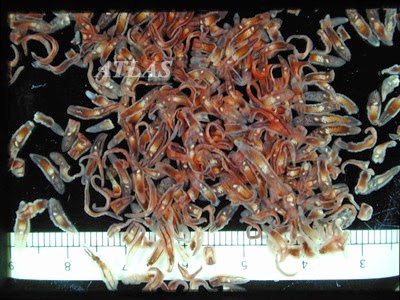
Clonorchis specimens from a patient.
These three parasites not only represent three different classes of organisms (and two different phyla if you are keeping up taxanomically), they also represent parasites found in different types of fish. C. sinensis is typically found in freshwater fish or in fish that prefer brackish waters (a mix between freshwater and marine ecosystems). This parasite is really only found in East Asia, where it utilizes a snail for its first intermediate host and a fish as its second intermediate host. The parasite has been known to be problematic in regions that import fish from East Asia in addition to popping up in local populations where it is endemic. It is also interesting to note that this parasite has been identified in mummies and coprolites from Korea. This tells us that humans have a long history of association with this particular parasite.

The fish tapeworm, D. latum, also boasts a long association with humans. Coprolites from both North America and from South America have tested positive for this parasite. Some of the earliest New World human populations were infected with fish tapeworms, which makes sense given their proximity to water sources and diets that often integrated fish. A diet that included fish is evidenced by the existence of bones and scales in macroscopic remains from coprolites as well as in artifacts constructed from fish bones. This parasite infects freshwater fish, such as trout, and can be found just about anywhere in the world. It is often diagnosed in campers/fishermen who do not properly cook their catches and in sweet little old Jewish ladies who taste test tainted gefilte fish before the dish is fully cooked.


Anisakis worms embedded in a herring.
The last of the three, A. simplex, is by far the most notorious. This roundworm is cosmopolitan in nature, like D. latum, but prefers for its hosts to be marine fish as opposed to freshwater fish. It is most often associated with mackerel and herring, which has earned it the common name of "herring worm". Apparently it can infect many other marine fish and even things like squid. It has been contracted from dishes around the world including sushi/sashimi, cod livers, fermented herring, and ceviche. Though a person can experience mild to moderate abdominal pain after contracting one of the other two parasites mentioned here, a person contracting A. simplex will experience much more violent abdominal pains. These pains are sudden and severe by comparison because these worms actually die when they fail at their attempts to burrow into your intestines.  This often instigates an IgE-mediated immune response (i.e. an allergic reaction, sometimes even anaphylaxis), making this parasite by far the most dangerous of the three discussed in this blogpost.

Ceviche
There are a great variety of symptoms to look out for if you think you may have picked up one of these parasites. Because they affect the digestive system, you may experience things like abdominal pain, vomiting, nausea, loss of appetite, and diarrhea. The first of the three parasites, C. sinensis, primarily affects the liver and may lead to hepatomegaly (enlarged liver) and jaundice. The fish tapeworm, D. latum, can cause irritability or muscle weakness in addition to numbing or tingling of the skin. It may also manifest as an elevated heart rate. The most prominent symptom for an A. simplex infection is the sudden and severe abdominal pain. As the parasites die, they can also cause anaphylactic shock or they can leave behind intestinal granulomas, which many times mimic the symptoms of people with Crohn's disease.


Now that I have you thoroughly terrified, let's talk about how much effort we go through to prevent ourselves from being infected. In the U.S. (and probably many other places), we have regulations pertaining to the serving of raw fish. Raw fish, no matter where it comes from, must be processed to make sure that parasites are killed. This is done by freezing and/or treating with salt and/or chlorine. The FDA states that freezing temperatures and times vary with the nature of the fish to be frozen and the parasites to be killed. It seems that they recommend between -4 degrees F or less for 7 days and -31 degrees F or less for 15 hours for most cuts of fish. Thicker cuts need to be kept colder longer. The FDA goes on to say that brining and pickling are not safe ways to control for fish parasites as they are not effective methods for reducing parasite threats. Recent studies have shown that while not optimally effective alone, treatment of fish with chlorine in conjunction with ultrasound processing significantly reduces parasites in fish meat. Using an ultrasound for at least 30 minutes is another method for controlling for fish parasites that seems to work pretty well. The only other method that this author knows about is treating the meat with at least 15% NaCl (salt) after 7 days of storage. The paper I read about that bit pointed out that 20% NaCl was better and could be used after only 6 days of storage. I'm sure there are other methods, but these seem to be the most prominent as far as I can tell.

The risk of actually contracting these parasites in the United States is low. The liver fluke (C. sinensis) is extremely rare in the U.S. with most reported cases demonstrating patients who contracted the parasite in another country before coming to the US. Infections with D. latum are also rare in the U.S. despite once being common in people living around the Great Lakes. Recent cases have popped up from the West Coast, but are still not very prevalent. There are less than 10 cases of anisakiasis reported each year in the U.S.

The other bit of good news is that if you happen to contract any of these by some off chance of bad luck, they are almost never fatal. Additionally, they are rather easy to treat with drugs readily available here in the states.

The Moral of the Story
Don't ever let anyone make you feel bad for eating sushi...unless you are in a country with poor food regulations and the food looks sketchy, then you should definitely not eat the sushi. Use good judgement and know the warning signs just in case. You should be able to get plenty of good sushi, sashimi, gefilte fish, and ceviche here in the US of A since we make it a point to be especially careful when handling raw fish. Go celebrate with a dragon roll or some ebi!!!


Mmmmm!!!

Saturday, December 21, 2013

Here's Lookin' at You, Giardia

Oh, Hi!
Arguably one of the most adorable of the diarrhea-causing protozoans would have to be members of Giardia. Sure, they cause terrible fatty stools, intestinal pain, and dehydration, but hey, at least it looks cute while doing it. I used to think that this parasite caused bloody stools, but I recently learned that this is not the case with Giardia. Rather, stools become "fatty". You see, as these parasites feed on mucous secretions within the intestinal walls of their hosts, they cause considerable damage to the microvilli and make it difficult for the intestine to absorb fats and other nutrients. This causes diarrhea and the aforementioned "fatty" stools. This parasite has been infecting humans for many, many years. Not many years ago we discovered that Giardia played a role in causing much of the dysentery contracted by the Crusaders in the 12th and 13th centuries as they invaded Palestine. The parasite didn't make its
grand appearance onto the world stage  until 1681, when Van Leeuwenhoek saw it for the first time. He found it as he examined his own stool during a bout of diarrhea exclaiming:

"My excrement being so thin, I was at divers times persuaded to examine it; and each time I kept in mind what food I had eaten, and what drink I had drunk, and what I found afterwards. I have sometimes seen animalcules a-moving very prettily..."


But I suppose I'm getting a bit ahead of myself. Let's start with the basics.

Taxonomy
As with any discussion of protozoan systematics, please keep in mind that as researchers discover more about these creatures their taxonomic categorizations tend to change. It is likely that even the upper taxonomy I am about to describe has since changed and I myself could easily be behind the times as I don't study this parasite exclusively and am not familiar with the latest taxonomic literature regarding this group of organisms. Like many other things, protozoan taxonomy exists in a state of perpetual flux. Disclaimers aside, this group belongs to Phylum Retortamonada as it lacks both dictyosomes and mitochondria. Members of this group are all flagellated and are either intestinal parasites or live freely in anoxic kinds of environments. They further belong to Class Diplomonadea and to Order Diplomonadida. Members of this order have two karyomastigonts (nuclei and associated organelles) and twofold rotational symmetry. Giardia further belongs to the Family Hexamitidae for having two equally-sized nuclei arranged beside one another. This morphological feature gives them that endearing "looking at you" feature that's made them so famous.

Interestingly, there have been more than 40 species described from this genus, but many of these have now been rendered invalid with the advent of molecular biology. Today, only five species are considered valid species within this genus. Two species within this genus infect birds, one infects amphibians, and two infect mammals. Of those two, only one causes disease in humans: G. duodenalis (formerly known as both G. intestinalis and G. lamblia).

From an evolutionary standpoint, Giardia duodenalis is interesting to study. It's simplistic life and primitive  morphology tells us that it is among the oldest of the protozoans. These guys are a basal group of protozoans existing before the development of mitochondria found in other protist groups. They also possess many flagella, which is also thought to be an ancestral condition.

Life Cycle
The life cycle of this parasite is simple. Fecal-oral contamination. Something that is infected poops in a place where the parasites won't dry out. At this point the parasites are in a cyst stage of their life cycle. When someone eats food that has been accidentally contaminated or drinks from a Giardia-rich water source, they pick up these cysts. Once in the body, the cysts transform into feeding stages known as "trophozoites". Trophozoites attach onto host intestinal tissues and feed off of the mucous linings causing all sorts of problems as it does so.


Giardiasis (a.k.a. "Beaver Fever" or "Recreational Water Illness")
We are just hangin' out...
munchin' on some mucous, yo!
Infection with this parasite is highly contagious. It spreads rapidly in areas where sanitation is not G. duodenalis either. These parasites can be passed by dogs, cats, sheep, and even beavers (hence the first common name for the disease).  Infections are easily acquired from water parks, lakes, and even resorts (hence the second common name). It can also be contracted from unwashed fruits and vegetables, or from contaminated drinking water.

Much of the time, cases of giardiasis are so mild that they show no clinical symptoms. However, some cases include symptoms like incapacitating diarrhea, intestinal pain, weight loss, flatulence, dehydration, and excess mucous production. In severe cases, patients present with colic or jaundice caused by infections of the gallbladder. Because the parasites disrupt fat and nutrient absorption, dietary diseases can also be come an issue if left untreated long enough. There are very few fatalities, but the disease is certainly no picnic.

Diagnosis
Most of the time giardiasis can be confirmed by examining a stool sample for cysts and trophozoites. Immunological techniques are also useful today. Things like ELISA testing or the use of PCR have been helpful in diagnosing giardiasis. In rare cases, duodenal aspiration is required to demonstrate these life stages if a person is not regularly passing the parasites. Now, I had never heard of duodenal aspiration, but it sounded like it wouldn't be much fun. Looking it up confirmed my suspicions. This involves passing a tube orally into the duodenum (part of the small intestine) and aspirating to dislodge the parasites for a proper sample. Nope. Not fun at all. Then again I don't know if that would be worse than the alternative, which would be an intestinal biopsy. Pick your poison.

Treatment
Lucky for us, being diagnosed is more difficult than determining how to treat a person with giardiasis. Metronidazole and quinacrine are the two drugs most often chosen to combat infection. This completely cures the patient in only a few short days. Because it is highly contagious, it is good practice to dose all immediate family members/roommates as well to avoid reinfection. It is equally good practice to determine the source of infection to take the measures needed to prevent future infections.

Seriously, even with all the symptoms, you have to admit these are adorable little guys!

A Colorful History
I want one!
(The plush, obviously.
Not the actual parasite
despite its cuteness.)
After appearing on Leeuwenkoek's microscope stage in 1681, this parasite went on to  pop up in many places around the world. Giardiasis outbreaks have occurred in many countries with a variety of impacts, ranging from small, localized epidemics to large-scale contamination of major city water supplies. As archaeoparasitology extends its reach into the realm of molecular biology, ELISA and other techniques are being utilized to reveal more about the effects of these parasites in both historic and prehistoric human populations. As mentioned earlier, a 2008 study pegged this parasite as part of the reason that Crusaders suffered from dysentery. How cool is that?! Other studies have revealed Giardia's presence in places far away, such as ancient Peru, as well as in places closer to home, such as a cemetery in Kansas dating from 1860 to 1900.

Moral of the Story
These ancient parasites are beginning to reveal to us more about the daily lives of people in both ancient and historic times the world over. They are teaching us that our ancestors suffered from some of the same things we struggle to combat even today despite our vast improvements in sanitation. Once again, here is a parasite to be admired...to be marveled at for its ability to survive this long as a species without something as fundamental as mitochondria. It's an easy parasite to love...it doesn't typically cause much more than discomfort, it's easy to treat, and let's face it, its morphology makes it kind of cute. (Plus you are very unlikely to die from it unless you refuse to get yourself treated.) Here's lookin' at you, Giardia.