Thursday, July 25, 2013

Cyclosporiasis: Coming to a City Near You!

Hello fellow parasitophiliacs! Sorry that this is a little late, we had a Field Parasitology class start here at the station so I've been too excited to take the time to write up this post.  A few weeks ago a friend sent me a link about a local parasite outbreak, so today we are going to discuss that parasite.

In 1854, John Snow made quite the name for himself by halting an outbreak of Cholera in London. He famously had the city remove the handle from the Broadstreet pump, thus stopping people from becoming further infected with the water-borne illness.  This summer, we had our own version of John Snow's problem...the difference was that we were dealing with a eukaryotic organism instead of a prokaryotic bacterium. Oh yeah, and people aren't dying of our disease, just getting really, really sick...and we aren't in London...and we have much more advanced ways of studying and halting the spread of infectious diseases...and okay, it's not the best analogy I suppose.  The point is, we have an outbreak on our hands that has grown rapidly in the midwest and we really need to figure out which pump is housing our contaminated water...or to be more accurate, what type of produce is most likely to be the carrier for this parasite.

Cyclospora cayetanensis in various stages of development.

Taxonomy
The scientific name of the parasite is Cyclospora cayetanensis.  It is a type of unicellular organism within the phylum Apicomplexa. It belongs in class Conoidasida because it possesses a structure known as a conoid.  It is further classified in the subclass Coccidiasina and the order Eucoccidiorida.  These organisms are commonly called simply "coccidians". Another well-known coccidian is Toxoplasma gondii, which can cause problems in pregnant women and people with compromised immune systems. (I'll stop right there about T. gondii...otherwise we would be here all day as that is one of my all-time favorite parasites.) C. cayetanensis is placed in the family Eimeriidae with many coccidians of veterinary importance, such as Eimeria tenella, which infects chickens.

Life Cycle
The life cycles for these protists involve direct contact with infected feces.  People most often pick it up by eating foods or drinking water contaminated by infected feces.  When a sick person deposits feces, the protists exist in a life stage called an oocyst.  These oocysts spend a few weeks outside of a host undergoing morphological changes until they develop the necessary parts to become infective. This developmental process is called sporulation.  After sporulation, a host eats whatever the parasites are contaminating and the process repeats itself.

Cyclosporiasis
The disease caused by C. cayetanensis is often called "traveler's diarrhea", but the medical term is cyclosporiasis.   Symptoms typically include fatigue, nausea, flatulence, and anorexia followed by watery stools, abdominal cramping, low-grade fever, gastroenteritis, and weight loss.  If left untreated, these symptoms can persist for about 57 days.

Diagnosis
The diagnosis of cyclosporiasis is fairly difficult because these protists are small and difficult to stain.  There are four commonly accepted methods for diagnosing this disease:


1-Finding it in a fecal smear (a.k.a. checking the poop)
2-Finding that these parasites are undergoing sporulation
3-Finding parasites in bowel biopsy or intestinal fluid.
4-Good old PCR (polymerase chain reaction).

The parasite also auto-fluoresces (glows) under a black light.  So using a UV light while performing microscopy can also be helpful for diagnosis.


Treatment
Despite the nasty symptoms, this infection is fairly readily cured. Current protocol describes using antibiotics (like trimethoprim-sulfamethoxazole for instance).  These drugs are administered over the course of about 7 days. If left unchecked for too long, or if the infection is very severe, some people do have to be hospitalized.  Luckily, very few people ever die from this disease.

Prevention
The best way to prevent contracting this parasite is to always thoroughly wash any produce that you have (especially raspberries, as you will see in a moment) and to make sure that you are getting clean water when traveling to countries with sanitation problems.  These parasites are often contracted by people traveling in  Peru, Brazil, and Haiti, but if you know your water is coming from a reliable source and your produce is properly washed, you should be fine. Outbreaks have occurred in the U.S. and in Canada from fruits imported out of Central and South America.

Recent Outbreaks
The most recent outbreak began in Iowa during June of this year.  When I first read about the outbreak, there had been 22 cases reported. As of today, there have been 138 confirmed cases in Iowa.  Many other states have seen an increase in cases as well. Nebraska jumped from 16 cases a few weeks ago (11 cases coming out of Douglas Co.) to 70 cases as of this morning. My home state of Texas has seen 66 cases. Georgia has reported 2 while Wisconsin has reported 3, and single infected individuals have popped up in Kansas, Ohio, Illinois, Minnisota, New Jersey, and Connecticut.  That brings us up to 285 cases spanning 11 states in the last month. Ten of these people wound up in the hospital and who knows how many cases have gone unreported.  This is certainly well above the average number of annual cases which has been around 150 for the last eight years according to the CDC. So far, no one has been able to determine what is causing the outbreak, but the best guess is some type of imported fruit was tainted.

Risk Areas for Traveler's Diarrhea: Green=Low, Off-White=Intermediate, Red=High

Less Recent Outbreaks
Someone had fun with Photoshop.
I thought this was pretty clever.
In 1996 there were over 1,000 cases reported in the U.S. and Canada that were linked to raspberries imported from Guatemala.  In 1997 an additional 90 cases from five U.S. states were reported.  These cases were also linked to berries that came from Guatemala and Chile.  More recently (2000), there was an outbreak where 54 people got sick after eating infected raspberries baked into an unlucky couple's wedding cake. Having recently planned a wedding myself, the thought of such a possibility is absolutely terrifying.

Moral of the Story
The biggest lesson learned from doing research for this post is that you should ALWAYS thoroughly wash your produce. These little guys can't burrow their way into the foods they are contaminating, so giving your fruits and veggies a good wash is really all it takes to save you from 57 days of things coming out of both ends. Also, if you are traveling, take extra care in paying attention to where your food and water are coming from. Finally, if you live in any of the areas in or around outbreak zones, be sure to see a doctor if you start to experience any of the symptoms of this disease.  Get yourself a strong dose of antibiotics and be glad you only had to suffer 7 miserable days of illness instead of 57!  Where is John Snow when you need him?  I bet he'd know nothing about cyclosporiasis anyway...(that may or may not have been a Game of Thrones reference...).

Is his name Guatemala? No? Alright, we'll blame Lone Star!

Sunday, July 7, 2013

The Not-So-Rare, Yet Still Uncommon Brain-Eating Amoeba

Greeting All! First and foremost I must apologize for my lack of blogging in the past month. As some of you may know, I've been working at a biological field station and time has sort of flown by here with all of the projects I'm currently working on. This is the first chance I've really had to sit down and type something up for all of my fellow parasitophiliacs.

My lame excuses aside, I ran across a clip this morning from a show called "Monsters Inside Me". I have seen this show before and liked what I had seen even though they make some things a little excessively dramatic.  However, this clip was appropriately dramatic.  This episode was about a family that lost their beautiful son and brother to an infection of Naegleria fowleri.

Some of you gasped when you read that scientific name (as you should) and others of you are sitting there with a confused look on your face.  Naegleria fowleri is a species of amoeba that becomes opportunistically pathogenic when its natural freshwater habitats are exposed to prolonged periods of high temperatures.  My first post was written about this parasite and can be read here for further information.

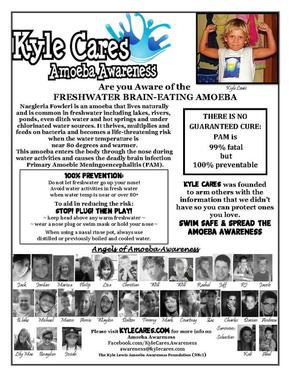
After watching the Monsters Inside Me clip, I Googled the name of the victim from the show.  His name was Kyle Lewis.  He was taken by the disease at only seven years old.  His family lives in Arlington, Texas (which is pretty close to home for me) and has started an amoeba awareness organization called Kyle Cares.  You can access the site from here.

After browsing the site for a bit and reading about other people who had been taken by these parasites, I began to notice that there were more confirmed cases than I had realized in the last few years.  For those who may not know, this disease is extremely rare despite the ubiquitous nature of the non-infective forms of the amoebae in the southern United States.  The disease caused by an infection of these amoebae is termed "Primary Amoebic Meningoencephalitis" or "PAM".  I've always learned, as I stated above, that this is an extremely rare disease.  However, this site claims that the disease is not as rare as many people think.  Upon further reading, I learned that have been nearly 45 cases reported since the year 2000.  Granted, this is pretty low, but it isn't nearly as low as I had imagined.  Last summer alone there were at least three confirmed cases of PAM in the U.S. between the months of July and August.  Below is a graph taken from the CDC's website showing how many cases of N. fowleri have been reported from 1962-2011.

a green bar graph on a white background showing the number of case reports of PAM by year, United States, 1962-2011. N=123; year of exposure unknown for one case.

This graph pretty much blew me away.  I had no idea that we had THAT many confirmed cases.  Upon further reading, I found this chart showing gender and age distribution of cases within the same dataset as the above graph.

Purple graph on a white background showing the number of case-reports of Primary amebic meningoencephalitis by age group and gender, from 1962-2011. N=123.

The final graphic I wanted to include in this post shows a time distribution in addition to a means of infection for the same cases used in the dataset above.

Multi-colored graph showing the number of case-reports of primary amebic meningoencephalitis, by month of illness onset and probable water exposure in the United States, from 1962-2011. Purple indicates lakes, ponds, reservoirs; light purple indicates canals, ditches, and puddles; rust-red indicates a river or stream; yellow indicates geothermally heated water; green indicates tap water, black indicates swimming pools, and gray indicates unknown or multiple locations.
As you can see, the parasites are most often pathogenic during the hottest months of the year and tend to be contracted from lakes, ponds, and reservoirs.  It seems to occur more often in males than in females and is found most frequently in children and teenagers...though it is certainly not limited to these genders or ages. 

This disease has a rapid onset and is between 97% and 99% fatal depending on your source.  The few who have survived this disease were given Amphotericin B...which has harsh side-effects from what I understand.  The Kyle Cares website mentions that a group of researchers out of California have found a possible cure for PAM that works in vitro, but I have not yet been able to locate this particular paper. (If anyone has a copy, please e-mail me!)  However, I was able to find a paper about a possible vaccine that a group of researchers in Korea have been working on.  The vaccine has a 90% survival rate in experimentally infected mice.  The big question here (other than the obvious, will it work for humans?) is whether or not a vaccine is practical.  If it would save lives, it would be practical for people who live or vacation near freshwater bodies that exceed 80 degrees F during the summer months to get vaccinated.  However, because the disease is relatively rare, does it really make sense to vaccinate everyone that we can?  These are issues for people with far more public health experience than myself, but I do find it to be a fascinating new development for the worlds of parasites and immunology.

Moral of the Story
I suppose the best thing to take away from this is to remember that our definitions of "rare" diseases may be a bit more fluid than what we realize.  Though this disease is by no means common, we do seem to have spikes in cases during the hot, dry summer months such as those we are experiencing right now.  The best idea is to avoid recreational water sports in lakes, ponds, etc. when the water is warmer than 80 degrees F.  Also, if you haven't already done so, consider popping over to the Kyle Cares website and donate to their cause for continuing research and providing support for families affected by N. fowleri.  Here's that site again, in case you missed it: Kyle Cares

Sunday, May 12, 2013

Mother Nature's Underground Art Gallery

I finally finished reading Parasite Rex a few days ago.  It was an amazing book, and if you haven't read it already, you should!  As I started thinking about what to write about for today's post, I started reflecting on the last chapter of the book.  I also started thinking about why I am so intrigued by parasites and why so many other people find them disgusting.  So, I decided that rather than talk about a specific parasite today, I would blog about how I came to be a lover of things that many people consider "repulsive".

To further preface this post, I've been living at a biological field station for a little over a week.  I'll be working here all summer doing various odd jobs and being a teaching assistant for summer sessions.  In addition to being a parasitophile, I'm also an araneophile (lover of spiders).  I started collecting a few spiders after arriving here just for funzies, but now I've fallen into working on building a permanent spider collection for the station since we don't already have one here.  Over the course of four or five days, I've already collected 30 specimens representing at least 6 different families as far as I can tell.  I will be ordering a spider identification manual soon so that we can officially identify what I've collected so far.  Like parasites, spiders are creatures of great beauty, complexity, and diversity that are vastly under-appreciated by the general public. 

What is it with me and liking creatures most people are disgusted by or avidly afraid of?  I pondered this question for a very long time last night as the thought of getting a spider tattoo crossed my mind.  Why a spider tattoo?  Because it would be more than simply a thing I found interesting, it would be highly symbolic of my growth as a scientist.  You see, I haven't always loved spiders...in fact, most of my life I was very much an arachnophobe.  I would squeal and stomp just like any girl would do despite being surrounded by them the majority of my childhood growing up on a farm.  I was also afraid of snakes and some of the more threatening flying insects like wasps and muddobbers.  I wasn't so keen on ants either.  But things change as we grow older, and more importantly wiser.

As a young biologist, I took a class in vertebrate zoology that made me decide I wanted to become a herpetologist (one who studies reptiles and amphibians).  I loved frogs and lizards and was even developing a fondness for turtles.  Then there were snakes.  Most people who long to be herpetologists love snakes...I was the opposite.  Snakes were the last creatures I wanted to study, but I knew that they sort of came with the territory if I wanted to be a herpetologist.  So I set out to change my fear of snakes into at the very least a mild tolerance.  I tried to handle them every chance that I got and I read up on how they worked and how to handle them safely.  In my quest for better understanding, I soon realized that many snakes were completely harmless to us humans.  I even started seeing some of these as "cute"...a word I never would have used to describe a snake in the years prior to college.  It wasn't long before snakes no longer frightened me, though I have a healthy respect for venomous ones like diamond backs (Crotalus atrox).

Later in my career I became a graduate student.  In working towards a general biology degree, I wanted to take all of the "-ology" classes I didn't get to take as an undergrad.  I filled my time with mammalogy (study of mammals), araneology (study of spiders), mycology (study of fungi), and entomology (study of insects).  I was delighted to take entomology because I wanted to learn more about butterflies and beetles...and I did.  I also learned about the dreaded wasps, bees, and ants that I had admittedly trembled in fear of before.  (I recall even locking myself in a bathroom until my now-husband came home to rescue me once because a wasp found its way into our home.)  But I wasn't about to let these little devils stand between me and getting an "A" on my insect collection.  I learned more about these terrifying creatures and I forced myself to capture some of them (though I also conned some of my friends into doing my dirty work).  As I became more knowledgeable about the complexity, diversity, and downright coolness of these creatures, my fears slowly evaporated into non-existence.  By the end of it, I was no longer afraid to approach nests of these little beasts.

Feeling confident about my ability to work with virtually any type of insect and feeling unburdened by the shackles of my former fear was intoxicating.  I didn't want to be afraid of anything that nature could throw at me anymore.  I had truly learned that knowledge is power.  Understanding something made it less scary...and the next natural step after conquering one's fear is starting to see the beauty in the biology of such magnificent creatures.  So I decided to step it up...I registered to take a class about spiders.  For an entire semester, I focused on learning about these creepy crawlers.  Just as with the metamorphosis I underwent with insects, I slowly began to shift my perspectives about spiders.  They weren't the things of nightmares...they were animals with fascinating behaviors, intricate physiology, and astounding beauty once you could appreciate them.  I came to call some of these "adorable" like the jumping spiders with iridescent chelicerae or the happy face of a crab spider.  Talk about a giant leap towards conquering my fears!

This was my most miraculous change and the experiences of that semester really started to shape how I saw both the natural world and how I viewed society in general.  These lessons made me realize that some of the most beautiful things are things you have to want to understand and you have to take the time to really get to know before you can appreciate the amazing insights they have to offer.  This applies to people as well.  I won't go too deep into my sociopolitical views as you aren't here to read about those viewpoints...but I will say that understanding diversity in nature really shifts the way we see diversity amongst human populations.  We start to see that people who are different from us have a place and a purpose in our society.  We start to understand that if everyone was the same, our societal ecosystem would be dull and also...more importantly...would not be healthy.  We need diversity in society just as any ecosystem needs more than one type of flower or more than one species of insect.  Diversity keeps things interesting, beautiful, vibrant, and healthy.  Diversity = Progress from a human societal perspective as well as from a biological perspective.

By this time in my career I had discovered the sweet love that dare not speak its name...no, I'm not a lesbian...I'm talking about becoming a parasitophiliac.  The world doesn't always see parasites in the best of light...in fact, the opposite is more often true.  However, I had begun to see the beauty in another group of creatures most people found disturbing and even disgusting.  I had fallen for stories of bizarre life cycles and unimaginable diversity.  Things that once seemed like creatures that rarely inundated hosts and caused problems for people and other animals started to seem much more ubiquitous and subsequently much more vital to a healthy ecosystem.  I started to learn that parasitism was an extremely common and successful way of life for a plethora of invertebrate creatures.  They lived in things, on things, and around things.  They seemed to be interwoven into every aspect of biology...genetics, immunology, ecology, you name it!  Being a parasitologist was more than understanding a single phylum or class of animals...it was about understanding biological principles in a broad sense as well as understanding specifics of whatever creature you specialized in working with. 

These creatures really do have a hand in every biological jar. One of the most fascinating aspects of parasitology is the insane intricacy of parasite evolution.  Parasites have been the driving force of adaptation in more species than I can count.  They have been the culprits behind many of the evolutionary arms races amongst a wide variety of host species.  As they become better at evading the immune systems of their hosts, hosts develop better means for detecting the presence of parasites and back and forth the battle rages.  They affect more than animal immune systems.  In many instances they affect animal morphologies, physiological processes, and even host behaviors.  Many parasites are master of host manipulation and behavioral modification.  They have developed an arsenal of clever ways to transfer themselves from one host to another. I think Carl Zimmer put it best in Parasite Rex when he said, "When it comes to the tapestry of life, parasites are the hand on the loom." How elegantly beautiful is that?

With such fascinating life styles, I don't understand how any knowledgeable person could not be fascinated or at the very least intrigued by natures most "terrifying" creatures.  From snakes, to wasps, to spiders and parasites...nature has shown me that choosing to stay fearful and ignorant keep you from ever seeing some of the really interesting and amazing things she has to offer.  Things that most people fear in nature or know very little about are often some of her best works of art. Her underground gallery is rife with stories and images that would evoke the most profound emotions and senses of wonder if only more people would take the time to find the exhibitions.  This is why I'm so passionate about the "disgusting"...this is why I love spiders and parasites.  Call me a biological hipster (the only form of "hipster" that I wouldn't punch someone in the face for calling me) but having access to mother nature's underground gallery makes me feel privy to the exclusive works of art that we all, in reality, possess the potential to see for ourselves in we just take the time to look.

Sunday, May 5, 2013

Dermatobia hominis: The Human Skin Bot

D. hominis larva
For those of you who haven't already heard, I made a journey across the state yesterday to my home for the summer.  I'll be spending the next three months working at a biological field station owned by the university I am attending.  Yesterday while sitting in the dining hall, I saw an adorable little rabbit hopping around the cedar trees.  The first thing I thought about was how I scared my roommate last week with a video of a bot fly emerging from a recently killed rabbit.  (You can view this video yourself here.)  When I awoke this morning and began thinking about what to write for today's post, I realized I had never really talked about bot flies.  So here we are! There were lots and lots to chose from, but I decided we would take a human perspective and look exclusively at the human skin bot (Dermatobia hominis) for this post.

Taxonomy
As you probably already know, flies are animals belonging in phylum Arthropoda under the class Insecta. All flies belong to the order Diptera, meaning "two-wing"; this is in reference to the fact that these insects have only one pair of wings as opposed to two pairs like most other insects.  The second pair of wings in most flies have been reduced to vestigial structures called "halteres".  These structures now function mostly as balancing organs and have a knob-like appearance.  This order houses about 120,000 species representing 140 families.  The family that contains bot flies is the family Oestridae.  This family is split into four subfamilies: Cuterebrinae (skin bot flies), Oestrinae (head maggots), Hypodermatinae (cattle grubs, ox warbles, and heel flies), and Gasterophilinae (stomach bots flies infecting horses and their relatives, elephants, and rhinos).  Our D. hominis is found in subfamily Cuterebrinae and is common from Southeast Mexico down through the South American continent, extending to Argentina and Chile. Though we call it the "human skin bot", it will actually develop beneath the skin of just about any warm-blooded animal...mammals or even birds.

Adult human skin bot fly
Life Cycle,
The life cycle of this fly is similar to other flies in that it involves the laying of an egg what will hatch into a larva, which will go on to form a pupa from which an adult fly will eventually emerge.  Unlike most flies that infect their hosts (a condition known as "myiasis" which we will discuss in a moment), this fly does not lay eggs directly onto their hosts' bodies.  Nope, these guys are much more devious. An adult female fly will catch another parasitic insect, like maybe a mosquito, and glue her eggs onto the insect's body with the opercula (little flaps that open to release the eggs' contents) of the eggs facing downward.  It is unknown how many different types of insect carries are used by D. hominis, but there are at least 48 different types of flies and on tick species that have been known to be carriers.  Once one of these carriers lands on warm skin, the opercula open releasing the larvae onto their new hosts.  The larvae then burrow into unbroken skin and make a home in the dermal layers of the skin, where they stay for about 6 weeks before burrowing out of the skin and falling into the soil where they form a pupa and undergo metamorphosis, emerging as adult flies ready to mate and restart the cycle.


Myiasis
Bot fly larva being removed from a leg
This is the clinical term for an infection of fly maggots.  This can occur either opportunistically, as is the case in facultative myiasis...a condition in which  a non-parasitic maggot accidentally winds up in a host, or it can occur as part of a parasitic fly's life cycle, which is the case with obligatory myiasis.  If one becomes infected with D. hominis, that is obligatory myiasis.  Myiasis can occur just about anywhere there is exposed skin for a carrier to land on.  In fact, I even ran across a case of penile myiasis...that's right, some poor schmuck got infected with a bot fly on his penis.  No matter the site, these types of infections cause painful lesions, but almost never results in secondary infections.  In fact, there have been reports that fly maggots actually secrete antibacterial substances that are alkaline in nature, making wounds unfavorable environments for bacterial growth!  How cool is that??!!!

Human skin bot fly larva

Treatment
No matter how awesome it is that these guys make antibacterials from their spit, they are not fun to have burrowing into your dermis.  The best way to remove a bot fly larva from yourself is to suffocate the little guy and then pull him out by squeezing or using tweezers.  There are several ways to suffocate the larva.  One way is to put tape over the wound, but this is not recommended as it can actually rip the larva causing problems with total removal.  Another, less damaging way is to apply several coats of nail polish to the wound, but this can be problematic when removing the nail polish and is easily applied incorrectly due to the nature of skin.  The best, most effective way with the easiest cleanup is to apply a generous coating of petroleum jelly to the wound.  Which ever method you use, leave the applied substance on the wound for about a day or more, then you can remove the substance and subsequently remove the fly.  Some sources say that a venom extractor (found in snake-bite first aid kits) can be very effective at removing these larvae.

Moral of the Story
I think if you get a bot fly,
someone should buy you this shirt.
If you travel south for research or for funzies, be sure to take both insect repellent and petroleum jelly.  A snake-bite kit wouldn't be a bad idea either! Also keep in mind that though these things seem scary, they have tremendous potential in the field of medicine.  Perhaps if we could isolate some of these secretions, we could get new forms of antibacterial medicines or even substances that can be used to treat necrosis (dying tissue).  Heck, maybe someone already has figured out how to do either or both of those things! The point is if you do get a bot fly, remember that it is easily treated and that you aren't likely to get any weird secondary infections. Easy enough to deal with...it's all mind over being freaked out by a parasite! :p

Sunday, April 28, 2013

Meet the Crimson Rambler

When I was a child, my mother...like many other mothers...used to say, "Good night.  Sleep tight. Don't let the bed bugs bite!".  Good advice for a child not sure what bed bugs really were...otherwise I'd probably have had nightmares!  I spent most of my young life thinking bed bugs were mythical because of that phrase.  As I got older, I discovered that they were very real creatures that actually do bite people as they sleep.  As you can imagine, I was filled with fear and panic when I first learned about how pesky these little buggers can be.  As I've grown into the young parasitologist that I am, these pests have moved from something I fear to something I find fascinating.  Like most other parasites, these guys have very interesting lives and guess what...they aren't terribly dangerous to tell the truth.  The worst they can do is be an annoyance and an extremely difficult one to rid yourself of at that.  So, today we look at the strange lives of these odd insects that have had aliases such as the "wall louse", "heavy dragon", "chinche bug", "redcoat", and my personal favorite, "crimson rambler".  

Taxonomy
These animals belong to the largest of all the animal phyla: Phylum Arthropoda.  Within this phylum they exist as members of class Insecta.  Something tells me you can guess what other types of creatures make up this class.  They belong to order Hemiptera, meaning "half-wing", which refers to the partially membranous wings of most member of this order.  Interestingly enough, not all members of this order have wings (as we see with bed bugs).  However, members of this order do all possess piercing-sucking mouthparts often called the proboscis. This is used for penetrating tissues..both animal and plant in nature. They further belong to family Cimicidae.  Members of this family are all wingless blood-feeders that seek out birds, bats, and humans. There are 22 genera within this family; twelve feed on bats, two on humans, and the rest on birds...typically birds that live in caves or along cliffs.  The three species that feed on humans are colloquially called "bed bugs" due to their nocturnal feeding habits.  These three are Cimex lectularius, Cimex hemipterus, and Leptocimex boueti. The first is the most commonly found species globally, but prefers temperate climates, while the second prefers more tropical areas.  The last is found only in West Africa.

Bed Bug Bodies
SEM of a bed bug.  The piercing mouthparts have
been artificially colored with purple and red.
As mentioned previously, these little bugs are wingless...actually, if you want to be technical, they have vestigial (reduced to the point of being useless) wings. As adults, they are small reddish-brown ovals reaching as big as 5mm x 3mm in size.  Newly hatched nymphs are transparent, but become progressively darker as they go through successive molts.  These insects use chemical signals to communicate with one another about nesting, feeding, and reproducing.

Coming Out of the Woodwork...Err...Cave-work?!
These insects can proliferate quickly and be extremely difficult to eradicate once they have an established home.  But where did they originally come from?  Though no one can say for sure when or where bed bugs originated, we do know that the three species that feed on humans are also known to feed on bats.  It is likely that humans picked up these parasites from living in caves alongside infested bat colonies.  C. lectularius has also been known to feed on rodents, which may have helped to spread these insects into human dwellings outside of caves.

There is a long and fascinating history associated with these little bugs, but I'll save that for a future post. Today, we are experiencing a time of resurgence in bed bug populations.  As more people take over the planet, we build more places to house more people in fewer areas.  This space-saving comes with a price. Not only are apartments, dorms, and condos more prone to infestations with cockroaches and ants, now we are seeing more and more cases of bed bug infestations as well.  As you probably would have guessed, they are a bigger problem in places with larger populations.


The Feeding: Adventures of the Crimson Rambler
After closing your eyes and drifting off to dreamland, these little creatures make their way out of mattresses, dressers, pillows, and cracks or crevices in the walls near your bed. They find their way to you by detecting the carbon dioxide you exhale with every breath, by feeling the warmth of your body heat as they get closer, and by using a variety of navigation chemicals.

After discovering your exposed skin, the creatures pierce you with their tiny little beaks.  This blood derrick finally strikes paydirt when it enters into a blood vessel.  From here, the pressure within the vessel itself forces this iron-rich liquid into the body of this miniscule beast. Their bites are not painful and often go unnoticed in the beginning. The wounds left behind eventually become small itchy welts around your neck, arms, and jaw. The bug draws on the fresh blood for the next 5-10 minutes before dropping off and crawling back into the home from which they emerged. This is a ritual that occurs every 5-10 days.

Despite the fact that these creatures tend to feed once or twice a week, they can actually go for about 5 months without feeding under typical conditions.  Under ideal conditions (for them) they can live for up to a year.  Speaking of time, here's a fun fact: These insects digest their blood meals slowly and human DNA can be recovered from bed bugs up to 90 days post feeding!  This gives them a unique place in forensic entomology for determining whether or not a person was in a place where the bed bugs were found!
Male (behind) traumatically inseminating a female.
And the Most Traumatizing Mating Ritual Goes To...
One of the things that I've always found most fascinating about bed bugs is their means of reproduction.  These animals mate when a male finds a female, grabs her from behind, and literally stabs her in the abdomen with his hypodermic genitalia.  That's right hypodermic genitals.  After the stabbing, he ejaculates into her body and the sperm swim around in her hemolymph until they reach sperm storage structures.  Eventually, the sperm are released and move to the ovaries where fertilization occurs.  This process is appropriately called traumatic insemination.

Human Health Issues
Bed bug welts.
Despite being exclusive blood feeders, and being known to become infected with over 28 human pathogens, these animals have never been documented to have transmitted any diseases to humans.  The worst that these bugs can do is cause skin irritation that may be mild or could cause blisters in sensitive individuals. The biggest problem humans experience when living with bed bugs is the psychological effect associated with living in an infested home.  Much fear and disgust surrounds these organisms, and it is easy to have such feelings when faced with an infestation. 

These bugs are often associated with sub-par living spaces in our minds, but the truth is that a home can be a very nice home and still get an infestation.  They can be brought into a home through clothing, luggage, furniture, etc. from an infested home.  They can also come from wild animals or pets that have been exposed to nesting sites.

Detection and Management
Bed bugs are not always easy to detect because they are nocturnal feeders, usually feeding in the wee hours of the morning.  If you haven't had any reactions to the bites, you can still detect bed bugs by finding their fecal spots, blood smears on your bedding, or empty exoskeletons left behind as the insects molt.

A bed bug harborage.
Sometimes you can find a single bed bug, but they are more often found congregated at nesting sites.  These clusters of bed bugs, young and old, are often known as "harborages" and are the end of the chemical trail after feeding for most of these insects.  Harborages can exist in bedding, luggage, furniture...even electrical sockets and laptops.

Some people employ the help of specially trained bed bug detection dogs to help them find harborages.  Apparently, these dogs are very good at their jobs.  Under controlled lab conditions, these dogs are 97.5% accurate.  Of course, we expect that rate to be lower under real-world conditions, but that's still pretty impressive! Bed bugs are said to have a smell that some describe as rotting raspberries.  Trained dogs can typically pick up on the origins of these smells within minutes, which pest control specialists usually need about an hour.
A New York bed bug detection dog.

Bed bugs die if exposed to 115°F heat for 7 minutes or more.  Heat along with pesticides like malathion are the best course of action for managing bed bug infestations.  These animals can also be killed by freezing temperatures, but this takes several days rather than a matter of minutes. It is also recommended to vacuum areas, heat treat bedding and mattresses, and above all else to call in professionals to help with eradication efforts.  In extreme cases, you may have to dispose of a heavily infested mattress or couch.


There was an interesting paper that came out recently talking about a traditional method of bed bug control that involved the use of plant leaves scattered around the bed as traps.  Apparently this method actually works to some degree and scientists are working to develop artificial traps that have the same design as the hairs on these bed bug-snaring leaves.  More about that paper in a future post.


Bed bugs and their eggs
inside an infested dresser drawer.
To prevent bites, try to minimize the amount of skin you leave exposed while you sleep and think about infesting in a pesticide-impregnated mosquito net until you know you have gotten rid of these insects.  To prevent bringing these guys home be careful of secondhand items and sketchy hotels. Keep your luggage off the floor when possible in hotels, even non-sketchy ones may be infested. Bed bugs don't need a dirty place to live...they just need a place with hosts and lots of hiding places. Also, be sure to thoroughly look at your personal items after a trip...especially if you were in close proximity with birds or bats...and be sure to wash your trip clothing with hot water and dry them in a dryer for at least 20 minutes at a medium-high heat.

If you do develop skin problems from bites, you can treat them using a hydrocortisone cream or an oral antihistamine like Benedryl.  The bites usually heal within a few weeks.

Moral of the Story
If you get bed bugs, be sad that you have something hard to get rid of, but happy that you have something that can't transmit any sort of deadly disease! (Always a silver lining!) These creatures are fascinating even though they cause a lot of human annoyance and can be costly to eradicate from your home. Be in awe of the crimson ramblers...just hope you never have to deal with them up-close and personal! :p

Sunday, April 21, 2013

Avian Trichomoniasis: A Disease that is for the Birds

Last night I got home from the 46th annual Southwestern Association of Parasitologists' meeting.  I spent Thursday night, all day Friday, and Saturday morning immersed in conversations about parasitism among other exciting topics.  My little notebook is clutter with little thoughts that popped up during the numerous and exciting presentations given by everyone from undergraduates through tenured professors.  When I sat down to create a post for today, I had a hard time deciding which topic to pick!  Then I remembered that I will be able to post on everything I learned in good time. One thing that was barely touched upon sparked my interest.  Rather than posting about something I learned a lot about (you know, the logical thing to do) I decided to post about something I had to do a little research about.  This wasn't the first time I've ever encountered Trichomonas gallinae, in fact, I mentioned it once in a blog about dinosaur parasites.  But I've never written anything else about it, and I would like to change that. So, here it is, a blog post about something that was barely mentioned and scarcely discussed at a meeting full of parasitophiliacs, just because I can.

Trichomonas gallinae is not a human parasite.  This parasite instead infects a variety of birds.  It is most often found in columbids (doves and pigeons) but has also been known to infect chickens (no wonder with an epithet like "gallinae"...the scientific name for a chicken is Gallus gallus), turkeys (which are in the same order as chickens...the order galliformes), and a variety of raptors (birds of prey like hawks and eagles).  As late as 2005, reports of the disease were coming out about new bird host species.  The disease is widespread and, as you may have already guessed, very much not host-specific.  But before we go any further, let us look at this protist's taxonomic status.

Taxonomy
 Like all protists, this organism is a eukaryote, separate from bacteria and archaea by the presence of true, membrane-bound organelles.  There are many debates about upper taxonomy, so to avoid doling out information that is not up to date, let us skip to the class level.  This organism is placed within class Parabasalia, which is thought to be one of the oldest classes of protozoans. These primitive, unicellular organisms lack mitochondria and function anaerobically.  Parabasalids are characterized by the presence of one or more clusters of flagella emerging from the anterior end of the cell.  They are named for the parabasal fibers that run between basal bodies and Golgi complexes within the cell  There are 10 orders within this class, most of which are known to live within the guts of insects (both as parasites and as symbiotic mutualists). They are further placed within the order Trichomonadida based on their morphological characters.  Member of this order usually have 4-6 flagella with one being "recurrent", meaning that one runs the length of the cell and presents much like an undulating membrane.  Those within this group that are parasites (and not all of them are) never form a cyst stage.  Instead they remain in mobile feeding stages known as "trophozoites".  Because they do not usually form a cyst stage, the major means of transmission is via direct contact. This protist belongs in the family Trichomonadidae under the type genus Trichomonas.  Members of this genus exclusively parasitize vertebrates, but non-parasitic members can be found as endosymbionts within the guts of termites. One member of this genus, T. vaginalis, parasitizes humans and is spread through sexual contact.

Life Cycle
Trichomonas gallinae has a relatively simple life cycle compared to say, most parasitic helminths.  But that doesn't make it uninteresting.  These parasites are typically found at the anterior ends of the digestive and respiratory tracts of birds or in the oral-nasal cavity of such animals.  These organisms are able to reproduce quickly via binary fission while inside a suitable host.  Again, these organisms do not form cysts, so they often die rather soon after expulsion from a host.  They move from one host to another in one of three ways:

1) As a parent bird regurgitates food or crop milk (a secretion produced by pigeons, doves, flamingos, and some penguins that includes partial sloughs of the lining from the crop and contains a great deal of protein, fats, anti-oxidants, and immune supplements including antibodies and digestive bacteria) to feed their young, the parasite can get picked up as the food passes through the upper digestive tract and/or oral cavity and transferred to the young upon ingestion. This is the main source of transmission among doves and pigeons, which could be why the parasite is so prevalent in these types of birds.  Adult birds may carry the disease asymptomatically for years...spreading the disease to their offspring long before manifesting clinical signs of infection.

2) Trophozoites can survive for a short time in water, where an uninfected host may pick up the parasite through drinking. This means of transmission is highly problematic for domesticated chickens and turkeys that drink from water or ingest food that may be contaminated with feces, saliva, or a variety of secretions coming from the crop.  Wild birds have been known as sources of infection among domestic birds, but domestic birds keep the transmission cycle going within their own flocks through this form of transmission.

3) An uninfected bird may eat an infected bird and acquire the infection in this manner. This is an especially common means of infection for birds of prey, for reasons I'm sure you can imagine.


Avian Trichomoniasis
This disease is typically found in young birds and can be found in a wide variety of virulence patterns.  Adult birds that have been infected and have recovered carry the parasite, but become resistant to reinfection.  Because of the dynamic virulence of these parasites, the rates of birds infected are not closely linked to mortality rates.  Sometimes infections are mild or even asymptomatic for years.  Other times, the disease can result in death a mere 4-18 days after infection.


The disease presents as lesions within the mouth cavity that appear white or light yellow.  The lesions result in mucosal inflammation and ulcerations that expand into the esophagus, proventriculus, and crop.  As the disease progresses, the lesions create masses of dead (necrotic) tissue that may block the passage of food and/or air.  This may cause so much pain that the birds no longer wants to eat and suffers from subsequent starvation, or it may cause emaciation or asphyxiation as the esophagus and trachea become obstructed.  In rare instances, other organs such as the liver, or the eyes can become infected and will manifest such lesions to cause organ failure.


Diagnosis, Treatment, and Prevention
Avian trichomoniasis may be diagnosed based on clinical signs such as difficulty swallowing, inflamed mucosa, and excessive salivation or by direct observation of characteristic lesions/nodules within the mouth.  The only way to confirm infection is to demonstrate the organisms microscopically from samples of fluids, nodules, or lesions.


The most efficient treatment is the administration of antiprotozoal drugs like dimetridazole or metronidazole.  Birds typically recover in as little as 1-2 days after administering such drugs.  Sometimes, oral plaques have to be removed manually using forceps before drug administration.

For domesticated birds, the best form of prevention is regular cleanings of feeders and water sources.  It is also important to try to reduce contact with wild birds that may transmit the disease or at the very least protect food and water sources from wild birds.

The spread among wild birds can be reduced by regularly cleaning wild bird feeders and bird baths, allowing adequate drying time for both before refilling them with food or water. These parasites have never been known to infect humans, but in the interest of safety from other type of avian zoonoses, it's a good idea to wear gloves when completing such chores.

Moral of the Story
First of all, writing this post taught me that just because something is grazed over at a meeting of people who love parasites doesn't make it any less significant or interesting than any other parasite. From doing the actual research itself, it is important to know about such things if you ever plan to raise domestic birds as pets or sources of meat/eggs/feathers.  It is equally important to know these things if you are a wild bird enthusiast with a backyard of bird feeders and stone baths for inviting your winged friends to join you for a mint julep on a nice, sunny afternoon.  So, keep your bird-areas clean as best you can and hope for mild cases for the birds beyond your treatment/prevention capabilities.

Sunday, April 14, 2013

Long Live the Broad Fish Tapeworm! All About Diphyllobothrium latum


You may or may not be aware that eating certain foods puts you at risk of picking up parasites such as Diphyllobothrium latum.  Don't worry, I'm not going to try to talk you out of eating sushi or ceviche...I would never do that because I am a lover of both! However, it is good to be aware of the dangers of such foods so that you know what you are getting yourself into...especially in places other than the states where regulations are...less stringent, to put it mildly.  The bad news is that this parasite can go undetected for many years, and may get to be about 30 feet long in humans.  The good news is that once you've been diagnosed, our old friend Praziquantel can knock out in infection rather quickly.  So sit back, and enjoy learning about this fascinating fish tapeworm!


So what is this parasite you speak of?
Sushi from a restaurant in Chicago...I ate most of this!
Diphyllobothrium latum is commonly known as the "broad fish tapeworm".  As this common name implies, it is contracted from eating raw or undercooked fish and has a broad morphology, which we will mention again a little later. The worm is native to Scandinavia, western Russia, and the Baltics, but has been spread to North America through fish importation.  It has been historically more problematic in the Pacific Northwest than anywhere else on this continent.  As Americans expand their culinary pallets to include foods with raw or undercooked fish as the main ingredient, the risk for cases of parasite infections have increased.  Cases of infection have been reported from a variety of foods from many origins.  Sushi/Sashimi are among the biggest Asian threat.  Italian carpaccio di persico and French tartare maison make up some of the European threats. In Latin American cuisine, ceviche is a candidate for transmission as well. Luckily, food standards have become more restrictive in terms of fish importation and storage in this country.  It is not likely that you will contract this parasite here in the US, but if by some chance you do, remember that it's easy to get rid of as long as you can confirm the infection.
Carpaccio di Persico
Ceviche
Taxonomy
Like all tapeworms, this animals belongs to phylum platyhelminthes under class Cestoda.  It further belongs to order Pseudophyllida because the adults of this species possess two bothria (structures that help them attach to the host's intestinal walls) and dumbbell-shaped ovaries.  These worms also have both the genital pore and the uterine pore located in the center of their ventral (belly) sides.  D. latum belongs in family Diphyllobothriidae, which infect copepods, then later infect fish (usually), and wind up in mammals, where they grow to maturity and reproduce.  D. latum is the longest tapeworm species that infects humans, averaging 10 meters (30 feet) in length.  These worms may shed as many as one million eggs in a day.  The proglottids (segments in which eggs are produced...among other functions) of this worm are more broad than other tapeworm proglottids, hence the common name.

Scolex showing bothria on left. Proglottids on right.
Life Cycle
The life cycle of this tapeworm starts with an infected mammal shedding proglottids (laden with eggs) in their feces.  These proglottids get ingested by a copepod (this takes place in water) and the eggs develop into a procercoid larva. A small fish, such as a minnow, then eats the infected copepod and the parasite develops into a plerocercoid larva or "sparganum" within the fish's muscles.  Along comes a bigger fish that eats the smaller fish, and now the parasite can make a comfy home in the muscles of something like a trout or perch.  An unsuspecting human then eats the fish without properly cooking it to rid it of the parasites within, and now our human is infected.  Once inside the human, the parasites become immature adults and eventually develop into sexually mature adults.  They begin to reproduce, releasing their eggs in the human's feces and the cycle begins again.  These worms are restricted to humans, in fact many other animals have been reported to have harbored these worms.  There are papers describing this worm from dogs, cats, bears, weasels, and even pinnipeds (such as seals and sea lions)! Once established in a mammal host, this worm can live for up to 20 years, sometimes going completely unnoticed!


Diphyllobothriasis
The disease associated with being infected with D. latum has a long history with coastal cultures that have traditionally created foods using raw or undercooked fish.  Archaeological sites in South America have revealed eggs in 4,000-10,000 year old human remains. During the 1970s, there were over 5 million cases of diphyllobothriasis reported in Europe and over 4 million cases reported in Asia.  Symptoms of this disease are often asymptomatic (having no clinical signs or symptoms), in fact, 4 out of every 5 people who contract this worm show no signs of infection.  The remaining 1 in 5 infected persons experiences vomiting, diarrhea, and weight loss in addition to fatigue, abdominal pain, general discomfort, and constipation.  In prolonged cases, patients rarely suffer from severe vitamin B-12 deficiency as this parasite may absorb as much as 80% of B-12 within a person's body.  This deficiency can lead to megaloblastic anemia, which leads to demyelination (loss of the insulation around your nerves).  Demyelination leads to degeneration of the spinal cord
and may leave people with a variety of disfunctional nerve-related symptoms.

Diagnosis and Treatment
D. latum egg under a microscope.
Due to there often being a lack of clinical symptoms, many times this disease goes undiagnosed or gets diagnosed long after infection.  There are really only two ways to diagnose this disease.  The first way is to identify proglottids or eggs from a patient's stool sample.  The second way is to perform a PCR test following sonication to remove the eggs from the proglottids.  Sometimes, these worms can be found during a routine colonoscopy. Click here to see a video of this worm shot during a colonoscopy. Once diagnosed, the treatment plan is rather easy to administer.  Typically, a patient is given praziquantel.  This drug has some side effects that are similar to those that 1/5 patients experience from the infection itself.  Patients may also be treated with niclosamide, which has no side effects because it doesn't get absorbed by the gastrointestinal tract.

Prevention
One way to prevent the spread of diphyllobothriasis is to raise public awareness of water contamination and to encourage them not to defecate in sources of drinking water. One should always avoid eating any fish that looks questionable.  The best way to prevent the spread of this disease is to educate food handlers about how to properly prepare fish.  Fish should either be cooked thoroughly or brined before serving.  If a dish requires raw fish, the fish should be frozen at -10 degrees C for 2-3 days before being thawed and used.

Gefilte Fish
Moral of the Story
If you are planning to eat sushi or gefilte fish, be sure the fish have been prepared properly to kill off any little passengers that may have been hanging out in the fish muscles.  If you think you may have accidentally ingested a fish tapeworm, see a doctor so that you don't carry around your new friend for a few decades.  Also, don't be mad at D. latum, remember, he/she is just trying to survive!  And by the way, sushi is still delicious, so the risk of getting an easily treatable tapeworm infection is certainly not going to keep me from enjoying it! :P

See? We LOVE sushi!!! :p
Here's a close-up of the sushi bridge we ordered! :)