Sunday, February 24, 2013

Stem Cells in Schistosomes!

Good news everyone! A parasite-related paper was released on Wednesday in Nature that involved those monogamous little blood flukes we call the schistosomes! The paper was titled "Adult somatic stem cells in the human parasite Schistosoma mansoni" and it brought up some interesting new information regarding how these worms live so long.

These worms are well-known for their longevity. S. mansoni has been known to live for years, even decades within their hosts.  These worms live an average of 5-6 years, however there are reports of people becoming infected during childhood and not developing clinical symptoms until adolescence or adulthood. 

A composite image of a scanning electron micrograph
of a pair of male and female Schistosoma mansoni with
the outer tegument (skin) of the male worm "peeled back" (digitally)
to reveal the stem cells (orange) underneath. (Credit: Jim Collins,
Ana Vieira and Phillip Newmark, Howard Hughes Medical Institute
and University of Illinois at Urbana-Champaign)
This newly released study reveals that these worms may be able to achieve such long live spans through the use of stem cells. These findings aren't completely shocking.  These flukes are related to a type of non-parasitic flatworm known as Planaria.  These adorable little turbellarians are often used in zoology labs to demonstrate regeneration to students.  They have a remarkable ability to regenerate from longitutinal and transverse cuts because they house special stem cells known as neoblasts. Stem cells, by definition are able to develop into any type of cell the worm needs...blood cells, muscle cells, etc.  Neoblasts don't just help the Planaria regenerate damaged tissues, they also help to repair tissues that become damaged over time as the worm ages.

Lead researcher Phillip Newmark wondered if maybe schistosomes were living so long because they also had stem cells that repaired damaged tissues to keep the worms young. Following up on his suspicions, he and his team began searching for these cells in schistosomes.

They used fluorescent tagging techniques to find actively dividing cells within the blood flukes, then they isolated the cells and studied them.  Through their observations of these cells, they were able to determine that the cells divided to create two new cells: one that differentiated into another cell type (which varied) and one that was another stem cell.  This is characteristic about what is already known of stem cells.

Here's a quote from Newmark about the research:

The cells we found in the schistosome look remarkably like planarian neoblasts. They aren’t associated with any one organ, but can give rise to multiple cell types. People often wonder why we study the ‘lowly’ planarian, but this work provides an example of how basic biology can lead you, in unanticipated and exciting ways, to findings that are directly relevant to important public health problems.
 
This paper isn't insinuating that these neoblast-like stem cells are the only reason that schistosomes can live for so long, it is merely demonstrating that having these cells plays a role in their longevity. With continued research, it is believed that new treatments for curing people of schistosome infections will be created that target these stem cells for more efficient killing of the parasite.

Isn't biology fascinating?! There's always something new to learn about things that we have spent decades and probably millions...maybe even billions...of dollars researching! Yay for a field that is ever-changing and oh-so-exciting! :D

Tuesday, February 19, 2013

Zombie-Slave Spiders

I love spiders.  I'm also a big fan of zombie-lore, and of course of parasites.  This week, I decided to bring those three things together to tell you about a species of parasitic wasp that infects spiders.  This parasitic wasp (belonging to the genus Zatypota) hijacks the spider's body making it not only a zombie, but also a slave.  Infected spiders spin slightly abnormal webs to make better areas for the parasites' cocoons.

Zatypota specimen
mounted on a pin.

There are probably hundreds of species of parasitic wasps.  Most of theses belong in the family Ichneumonidae.  (In fact, they might all be in this family...but I can't remember, and I don't want to lie to you!) Within this family is a subgrouping that includes wasps that specifically parasitize spiders.  Members of this group are known as polysphinctine wasps. The female parasitic wasps use their ovipositors to insert eggs into the bodies of many different types of hosts...caterpillars, cockroaches, and as you will soon learn, spiders.  These wasps' eggs usually hatch within the host, using it as a food source, shelter, and in some cases as a vehicle to a more suitable emergence area.  Today, we will look specifically at a type of parasitic wasp that infects a spider that lives in the rainforests of Costa Rica.

Anelosimus octavius is a type of spider belonging in the trash-web family, Theridiidae.  This family is full of spiders with large abdomens that are carried in a distinctive way by members of this family.  I can't describe this very well...it's really something you just have to see to understand.  This family is also known as the family of  "comb-footed" spiders due to these neat little modifications they have on their back set of legs. Spiders in this family are also sometimes referred to as "cobweb" spiders because their webs take on a haphazard cotton-y appearance rather than the intricate patterns created by orbweavers or the distinctive sheets made by funnel-web spiders and their relatives.  Some of the more infamous members of this family include members of the genus Laterodectus...also known as black widows.

A typical web built by Anelosimus octavius.
Getting back to our little Zatypota, this wasp, like other polysphinctine wasps, modifies the behavior of their spiders hosts.  More specifically, these parasites modify the spiders' web-building behaviors. After a female wasp inserts its eggs into the spider hosts, the wasp larvae grow for about a week, feeding on the spiders' hemolymph for sustenance. Then, the larvae commands the spider to construct a modified "cocoon web".  Then the larvae emerge from their hosts, eat the hosts, then build a cocoon next to the cocoon web in which to pupate.  The idea is that these cocoon webs and other parts of modified web structures increases the likelihood of survival for the wasps by serving as additional protection during the pupal stage.

Central platform of web
showing top of wasp cocoon.

According to reports of observations of infected spiders, the hosts spend a great deal of time and effort preparing the cocoon webs for their parasites.  After tireless efforts, the exhausted spiders crawl back into the central part of the site only to become immobile  before being consumed by its parasite.  The following day, the parasite would began constructing its own cocoon right on top of the area where it ate its host.

It is interesting to think about how this could have evolved among these two species! However it happened, this is yet another awesome example of behavioral modification due to parasitism.  Hooray for making your hosts into zombies!


This is from a paper describing the odd behavioral changes induced by these parasitic wasps.
"Figure 2: Cocoon web of A. nr. studiosus (a) in which the wasp larva holds onto the densely-meshed central area just after having discarded the corpse of the spider. Lateral (b) and dorsal (c) views of wasp cocoons in cocoon webs of A. octavius, showing the radial pattern of lines around the upper end of the cocoon (c), and that the lines intersecting the cocoon (indicated by small “pimples”) are in the upper portion of the cocoon, with an open space below in which the cocoon hangs free (bar in (b)). The cocoon web spun from scratch in captivity (d) incorporated flat leaves (covered with white dust in the photo) as parts of the sheet."

Saturday, February 9, 2013

Toxo on the Brain

Toxoplasma gondii is one of those parasites that, once you learn about what it's capable of, you can't get it out of your head.  In some cases, that could be taken literally.  To learn the basics about this parasite, see this previous post.  Did you read it? Good! Let's move on.

Since the early 90's, scientists have known that T. gondii causes drastic behavioral changes in rats and mice.  It represses the animals' innate fears by essentially screwing with their brain chemistry until they start to actually like the odor of cat urine rather than being afraid of the scent.  This behavioral change is believed to be instigated by the parasite in order to get it into the definitive host (a cat).

Those studies were vastly interesting, but in recent years scientists have begun to find correlations between  toxoplasmosis and changes in human behavior.  Therefore, we will focus on the research presented with regard to human manipulation as opposed to rodent manipulations for the purposes of this post.

The idea that Toxoplasma could actually affect human behavior was radical when first proposed by a Czech biologist named Jaroslav Flegr.  His work has been highly controversial among people within the scientific community, but his diligence has paid off.  In November of 2012, a group of Swedish researchers discovered that this parasite hijacks white blood cells in order to make its way to the brain. Back in 2009, U.K. scientists discovered that this parasite has two genes for making a precursor molecule for the production of dopamine (1-DOPA, in case you were wondering). Upon further testing, it was found that the parasite induces the upregulation of dopamine production once in the brain of rats, and later it was found that infected humans also have increased levels of this neurotransmitter.

A Pseudocyst of parasites that forms in the brain.
The significance of increased dopamine production is how dopamine affects our behaviors. It was noted in rats to affect male and female rats differently, something that is, again, reflected in infected humans. In men, the increase in dopamine leads to a decrease in the production of the stress-hormone known as cortisol. This causes a spike in testosterone levels, which can drastically change a man's personality. These changes include increased aggression, social difficulties, increased dominance, impulsiveness, and a disinterest in the feelings of others (often to the point of psychopathy).

The increased production of dopamine in females causes very different changes.  Women's bodies are more adapted to dealing with increases in dopamine levels.  To cope with this, a female's body releases an influx of the sex hormones oestrogen and progesterone into the dopamenergic systems.  Unlike in men, this causes an increase in cortisol production in females, which drops the already low levels of testosterone.  Infected women tend to be less impulsive, more sensitive to the needs of others, more motivated, more outgoing, and more relaxed.  However, they do seem to experience hair loss and lowered libido in response to infection.

The personality changes described above become more drastic over time. Regardless of gender, infected people have been shown by some of Flegr's studies to be almost twice as likely to be involved in a car accident.  This is because the parasite leads humans to having slower reaction times and increased fatigue.  Infected people have an increased risk of both suicide and of developing mental problems for which they will need to be institutionalized for their own safety.  There are also many links between toxoplasmosis and psycological disorders. Mood disorders such as bipolar disorder and clinical depression have been connected  with infection as has obsessive-compulsive disorder.

The disorder that has been most studied in connection with toxoplasmosis is schizophrenia.  Dopamine plays a big role in the development of schizophrenia.  Many people diagnosed with this disorder test positive for Toxoplasma gondii antibodies.  The link between schizophrenia and toxoplasmosis is still being studied, but it makes sense that an interplay could be present due to their connections with dopamine.

Toxoplasma gondii in green,
multipling inside a dendritic cell.
I mentioned earlier, it was recently discovered that the parasites hitch rides on white blood cells.  To be more specific, they grab hold of dendritic cells and use them to get into the host's brain. To get the dendritic cells to move, the parasites induce these cells to produce GABA (a neurotransmitter).  Like igniting a flame, the release of GABA by the dendritic cells excites GABA receptors outside the cell and sends it blasting through the body until it reaches the brain.  Another interesting thing about GABA? Changes in GABA levels are associated with psychiatric disorders such as...you guessed it...schizophrenia.

Now let's switch gears...we know that this tiny, single-celled protist may be the cause of some serious neurological disorders and that it induces some interesting changes in personality.  But this parasite isn't all bad, it has been reported that women infected with an asymptomatic form of toxoplasmosis (known as "latent toxoplasmosis") may benefit from the infection.  It seems that women infected with this prior to pregnancy are protected from contracting acute toxoplasmosis and their fetuses are protected from getting congenital toxoplasmosis! How cool is that?

It gets cooler!  Some scientists are doing cutting-edge research on using this parasite to TREAT neurological problems.  Yes, you read that right!  It seems that controlled infections can help people with problems relating to decreases in dopamine, such as ADD and ADHD.  It is also being used in researching treatments for both Parkinson's disease and Alzheimer's disease!

I guess that just goes to show you that there are two sides to every coin...or in this case, to every unicellular eukaryotic endoparasite! :p  With all of the advances being made in helminthic therapy, it will be great to see what medical science is able to do to utilize the manipulative capabilities of this parasite in the treatment of low-dopamine related disorders.
Who can resist posting rainbow pictures of parasites?!

Sunday, February 3, 2013

New Insights on Old Worms

As we've seen with past work, it's not easy to find parasites in coprolites that date back to 270 million years ago.  However, a team of researchers has found such diamonds in the rough...if you think of tapeworm eggs as tiny diamonds, and fossilized shark poop as the rough.

Shark coprolite containing 270 million year old tapeworm eggs.
These researchers published their work in PLoS One in January of this year (2013). From a Brazilian coprolite dating back to the Paleozoic era, this team found a group of 93 tapeworm eggs.  Like modern fish tapeworm eggs, these possessed a single operculum, and one even looked to contain a developing larva.  The oval-shaped eggs were beautifully preserved inside the coprolite encased within what appears to have been a proglottid. 

#1, this is awesome because it is the first time that tapeworm eggs have been recovered from anything that is this old.  We are talking older by FAR...these eggs predate parasites found in the fossil record dating back to dinosaurs. In fact, these eggs predate known instances of any form of vertebrate parasites by about 140 million years.  This sets the evolutionary time stamp much further back for intestinal parasites than we ever thought they had existed. (This is why biology is awesome! What we think we know today, could be completely wrong with the discoveries of tomorrow!)

This discovery will hopefully spur the interest of other researchers into doing paleoparasitology work.  It is absolutely amazing to have the definitive proof of the existence of something as soft-bodied as a tapeworm preserved for 270 million years.  This discovery was made from just one of over 500 similar coprolites located in a single area where researchers believe fish may have been trapped due to a dry spell.

270-million-year-old tapeworm eggs from a section taken from a shark coprolite.  In "A" you can see the proglottid surrounding the eggs.  In "B" you can see the eggs up close...the arrows indicate the opercula.

The state of preservation was astounding.  There was quiet a bit of pyrite (fool's gold) found in the coprolites, which tells us that the environment must have been pretty well depleted of oxygen.  Even though these coprolites can tell us a lot about the environmental conditions at the time of deposition, the exact species that deposited the coprolite will remain a mystery since all shark poop looks the same.

The tapeworm species is yet to be determined, but is similar to extant species found within Tetraphyllidea (which contains 540 extant species that parasitize Elasmobranchs).

I can't wait to see just how much more we discover about these little dudes in the coming year! :)

Monday, January 28, 2013

Clearing the Bad Air: Let's Talk About Malaria!

It occurred to me today that I have yet to post about one of the most famous and infamous parasitic diseases: Malaria.  The name of this disease literally translates to "Bad Air" because early conquistadors believed you could get it from breathing in...well...bad air.  This misconception came along as the Spanish pushed into the tropical regions of the New World and lost many lives to this strange new (to them) tropical disease.  It's interesting to note that although the Spanish believed  the disease originated in the New World, it has been established in recent times that the disease was actually brought to the New World by the Spanish...who brought with them slaves from Africa that were likely already infected.  Today we understand far more about this devastating disease.  Because of its prevalence in tropical regions and its socio-economic impact, this disease has probably been THE most studied parasitic disease.  Billions of dollars have been spent battling the disease and the impacts that it has on countries around the world.  But let's not get too far ahead of ourselves....

Taxonomy
Plasmodium (in yellow) bursting RBCs
Malaria is caused by protozoan parasites belonging in the genus Plasmodium.  Like all protozoa, these parasites once belonged in kingdom protista, but some texts now break that kingdom into several others.  In such texts, these belong to kingdom Chromalveolata under the subgroup Alveolata, or in some cases kingdom Alveolata may be listed.  While phylogeneticists debate the true kingdom-level classification, we will move on to more solid taxonomic statuses.  There are no debates at all as to which phylum Plasmodium belongs.  Because of the collection of organelles that function in host-penetration processes known as the "apical complex", these parasites and their brethren are placed within phylum Apicomplexa.  Because they lack a conoid, they are placed in class Aconoidasida ("a" meaning "without").  They are within order Haemosporida along with other malaria-like organisms and piroplasms.  And, naturally, they belong to family...you guessed it...Plasmodiidae.  There are four species of Plasmodium that infect humans: P. falciparum, P. ovale, P. malariae, and P. vivax.

Life Cycle
Ask any undergraduate biology student with a few years of classes under their belt to draw you the life cycle of Plasmodium.  Go on...I'll wait....Did they do it?...Correctly?...Awesome!  The life cycle for this parasite is often one of the first life cycles encountered by students of biology.  Let's start with the vector.  This parasite is spread via bites from female mosquitoes belonging to the genus Anopheles.  
Anopheles Up Close and Personal
As the mosquito bites you, tiny sporozoites wiggle their way out of the salivary glands of this vector and into your blood stream.  It rides the tide of your briskly moving currents of blood until it reaches the liver, where it invades liver cells (a.k.a. hepatocytes).  Here, the sporozoites undergo a rapid form of multiple asexual divisions known as schizogony to produce merozoites.  The merozoites break out of the hepatocytes and seek out red blood cells (a.k.a. erythrocytes) to infect.  Once inside, the host erythrocytes become transformed into factories producing additional merozoites and bursting (a.k.a. "lysing") to release 8-24 new merozoites that seek out more erythrocytes.  While some merozoites are content to continue to reproduce in this manner, others will develop into gametocytes.  When an uninfected Anopheles female comes around to take a blood meal from a person housing Plasmodium, many of the gametocytes are ingested with the blood.  These cells mature in the gut of the mosquito. Eventually, male and female gametocytes will fuse to create  zygotes (a.k.a. "ookinetes" in this case), which will eventually become sporozoites.  After developing into this motile, infective form, the sporozoites move into the mosquito's salivary glands and the cycle is complete.


Outsmarting Our Immune Systems
Plasmodium is a devious little dude.  These parasites are largely protected from the treat of a host's immune system because they live within cells rather than outside of them.  This hides them from circulating immune police, such as macrophages.  However, erythrocytes are prone to aging because they work so hard for our bodies.  When these cells pass through the spleen, they are checked for signs of damage or aging, and are subsequently filtered out of regular circulation.  The parasites becomes the cutting edge of anti-aging technology for these little cells by using proteins to prop up the cells, making them seem young to the busy spleen, and saving the parasites' homes for another road trip through the circulatory system.  Some species, such as P. falciparum, will even go so far as to produce adhesive proteins that force cells to stick to walls of small vessels in order to save themselves from being processed via the spleen.

Symptoms of Malaria
The symptoms of malaria may not appear until 8-30 days post-infection.  As the parasites enter into the phase of their life cycle in which they invade erythrocytes and force them to burst, people tend to spike fevers.  In some instances, people infected by P. viviax won't display symptoms for several months or even years post-infection.  This is because this species produces hypnozoites, which allow for long incubation periods and late relapses of infections.

The most common symptoms are flu-like in nature: headache, fever, shivering, joint and muscle pain, vomiting...but some are more severe such as anemia, jaundice, and retinal damage.  The most defining symptom is paroxysm.  Paroxysm is a period of coldness followed by chills and then by high fevers and sweating.  The time frame of paroxysm states is dependent upon the type of malarial parasite with which one is infected.

The World Health Organization (WHO) splits malaria cases into two categories: "Severe" and "Uncomplicated".  To be classified as "severe", one must demonstrate any of the following: decreased consciousness, significant weakness (e.g. inability to walk), loss of ability to eat, convulsions, low blood pressure, breathing difficulties, circulatory shock, kidney failure, red (hemoglobin-rich) urine, uncontrollable bleeding, enlarged liver, enlarged spleen, pulmonary edema, low blood glucose, acidosis, high levels of lactate, or an extremely high parasite level present in the blood.  The disease can progress to an even more severe form (if infected with P. falciparum) known as cerebral malaria.  This form presents with neurological problems such as seizures and comas.
 
Diagnosis, Treatment, and Prevention
Malaria is diagnosed by finding the parasites in a blood sample.  This can be through microscopic examinations of blood smears, or through antigen-based diagnostics tests.  The later is more accurate, but also more costly, and these tests are not yet sophisticated enough to tell how many parasites are present within a sample.  Polymerase Chain Reaction (PCR) has been shown to diagnose malaria efficiently, but is not widely used due to its complexity.

People diagnosed with malaria are usually treated using chloroquine in areas where Plasmodium isn't already resistant. Because resistance is so prevalent, most patients are also given mefloquine, doxycycline, or Malarone.  To prevent resistance, many places are now instituting the use of artemisinin-combination therapys (ACTs), which involves treating with traditional anti-malarial medications in conjunction with artemisinin compounds.  ACT is about 90% effective if used to treat "uncomplicated" forms of malaria.  When treated correctly, patients can experience a complete recovery. 
Various Anti-Malarial Medications
"Severe" forms of malaria were once treated with quinine, but now artesunate is more widely used because of its efficiency.  Treatment also includes supporting patients by helping them manage high fevers and seizures as they come and go as well as monitoring respiratory rates, blood pressure, and blood glucose levels.  This form of malaria can progress so fast that it can cause death within days or in some cases hours.

To prevent malaria, most tropical regions take on a three-pronged approach:
1) They give out prophylactic medications (if they can afford to do so).
2) They work to eliminate Anopheles mosquitoes.
3) They devise ways to prevent people from getting bitten by mosquitoes.

Prophylactic medicines are often the same medicines used for treatment (mefloquine, chloroquine, Malarone, etc.).  Travelers heading to malaria-endemic regions begin taking prophylactics a few weeks before leaving and continue taking them for about a month after coming back home.  (I personally took Malarone when I traveled to Panama for two weeks, and I didn't have any problems, but many people have side effects of this and other such drugs.)  This form of prophylaxis is not typically practical for residents of malaria-endemic areas because drug resistance and partial immunity can come from prolonged use.  This is also a costly endeavor, and has had many historical roadblocks.

To prevent mosquito bites, people can use DEET-based repellents and insecticide-treated mosquito nets.  Treating the nets with insecticides reduces the chances of mosquitoes living long enough to find a way to breech the nets themselves.
A woman tucks a mosquito net into her child's mattress.
 Some places have instituted spraying for mosquitoes (both indoors and outdoors).  Indoor spraying is highly effective as the mosquitoes tend to land on wall surfaces after taking in blood meals.  The WHO advises the use of 12 insecticides for such purposes.  Like anti-malarial drugs, these insecticides should be used in combination to prevent resistance.

Community-aimed educational programs are also helpful in preventing the spread of malaria.  After all, knowledge is power!  Seriously!  Teaching people to cover areas with stagnant water that could become mosquito-breeding grounds, as well as helping people to recognize the signs and symptoms of malaria can greatly reduce the number of malaria cases reported in an area.
An old poster encouraging people to spray for mosquitoes.

Ultimately, the best approach would be to prevent malaria rather than to treat it. (More cost effective and less costly in terms of human life.)  However, the monetary costs of instituting a program for prevention are beyond the means of the countries where malaria posses the biggest threat to public health.  Luckily, there are some amazing researchers (namely Jay Keasling...go on...Google him!) working to produce an anti-malarial drug that can be mass-produced cheaply.  Thanks to this kind of research, and humanitarian efforts directed at distribution, the next few decades are sure to reduce the number of annual cases of malaria.  It will be interesting to see how things change from a socio-economical perspective in response to a decline in a disease with such wide-reaching impacts on global health and economies.

Moral of the Story 
Though I could go on and on and on about malaria, this post has already gotten rather lengthy, so we will call it quits for today.  Maybe a future post will discuss the amazing way some populations have developed genes that prevent them from contracting malaria...or we could delve deeper into the work of Jay Keasling.  Perhaps a future post could discuss the history of malaria, an exciting tale of man's ups and downs as he fights to erradicate a disease that just won't seem to die.  For now, at least you can proudly say that you know the basics about malaria.  So if you ever travel to malaria-endemic areas, be sure to take your antimalarials (before, during, and after), sleep with a special insecticide-drenched, netted canopy surrounding your bed, and be sure to invest in plenty of DEET!

P. falciparum...because I can't resist a rainbow-colored image!
(Even if it is artificially done! :p)


Saturday, January 19, 2013

Leucochloridium paradoxum

Brood Sacs of L. paradoxum
 Sometimes (in fact, more often than not) parasites aren't satisfied with living inside a host, they feel the need to actually manipulate that host.  This is often the case with intermediate hosts like ants and snails that only serve the parasite for a part of the parasite's life cycle.  Parasites need to make it to their final host in order to reproduce and live out their adult lives.  In many instances, this means that the intermediate host needs to be manipulated in some way that attracts the parasite's definitive host so that the parasite doesn't have to wait around and hope that the intermediate host gets eaten by the right host quickly. This parasite is one such manipulator, and how it manipulates its snail host is a thing of both beauty and amazement.

Taxonomy
Leucochloridium paradoxum is also called the "green-banded broodsac" and is a type of flatworm belonging to phylum platyhelminthes.  It is a type of fluke, further classifying it as a member of class trematoda. It is a digeneid worm that falls into order strigeidida alongside the human parasite Schistosoma.  It belongs to family leucochloridiidae. It belongs in the genus leucochloridium, which houses many parasites of snails and other invertebrates.

Life Cycle
This parasite begins its life as an egg falling from the sky surrounded by a safety net of bird feces.  After landing in a splatter on the ground, a tree branch, or other area frequented by snails it waits for someone to come along that likes to eat bird droppings.  Enter an amber snail of the Succinea genus that shows up for a nice bird poop meal. The snail feasts upon the bird's feces and ingests our little parasite egg. 


The parasite makes its way out of the egg and takes the form of a miracidium. After living in the gut a short while, the miracidium begins to wander around the body.  Some of the miracidia will wind up near the head as the others overtake the snail's internal organs. The ones that reach the head change into their next developmental stage known as a sporocyst stage. In this stationary stage, the parasite begins to replicate itself until it produces a large "brood sac" that grows in size and begins to invade the snail's eye stalks. Here the sac begins to take on specific color patterns of yellow and green bands as it continues to grow. Within the sac, sporocysts are being produced, but so are the next life stage known as the cercaria stage.  Some cercariae stay in the sac as they are while others change into a metacercaria stage to await a bird gut paradise. The invasion renders the poor snail's vision in the infected eye stalk useless. (Most of the time only the left eye stalk is infected, but there plenty of instances were both eye stalks fall victim to these parasites.) 

Now the parasites override the snail's natural instincts to stay in dark areas safe from bird predators and forces the snail our into the light.  The light instigates a twitching movement of the brood sac.  This twitching becomes more rapid as the worms are exposed to more light.  The convulsing action of the eye stalk coupled with the coloring of the underlying brood sac looks like caterpillars to birds.

Along comes a bird looking for a tasty snack, and there goes the snail. In some cases, the birds only snag the eye stalk rather than eating the whole snail. When this happens, the snail is able to regrow its eye stalk, but the stalk is likely to be reinfected by some of the parasites already living in the snail's guts.

Now the cercariae in the bird's gut can make their way to the intestine and become adult worms. The metacercariae and sporocysts will change into cercariae and follow suit.  This bird's last meal has now created a new, large, vibrant parasite population with the bird's body.  The adult worms are monecious (having both sexes' reproductive parts within one individual) and will begin to cross-fertilize with other individuals or will self-fertilize to create eggs.  The eggs will be passed in the bird's feces, thus completing the parasite's circle of life.

That's for the Birds!
Despite the way that these parasites disfigure their snail hosts, they don't really cause any harm to their bird hosts. They live in the bird's intestines eating waste material and pumping out a LOT of eggs to ensure their species' survival.  After all, not all bird droppings get eaten right away...many dry out, which kills our little parasite eggs before they can be eaten by a snail.  Some sources say that shore birds are the preferred host for this parasite, and others say that birds like crows, sparrows, and finches are more likely to play host.  The only real criteria for a definitive host seems to be that the host be a bird living in temperate North American or European forests that house amber snails and like to eat green and yellow-banded caterpillars. The types of birds that do play host to the parasite are rarely eaten by humans, therefore human infection with this parasite is unlikely.


Peckhamian Mimicry and Extended Phenotypes
One of the coolest things about this parasite is how it can be used to teach people a variety of biological concepts.  First and foremost it displays an incredible ability to manipulate host behavior, a fundamental concept in studying parasites. It also brings up an important point about fecundity in organisms that have high egg mortality rates. If you know that many of your offspring are going to die, you can ensure your species' survival by producing an overabundance of eggs to compensate. These worms developed the ability to pump out lots of eggs in response to having a low egg survival rate.  That topic leads us into a discussion of evolution, which blows my mind with regard to how this species ever evolved such a complex and unique life cycle.

Continuing with the concept of evolution, one can bring up the idea of extended phenotypes.  An extended phenotype is the idea that a phenotype (outward expression of an internal combination of genes) does not have to be limited to internal biological processes like the creation of proteins that give rise to physical features. The idea is that one's phenotype can be extended to include the effects of a gene on the environment outside of an individual organism's body. This parasite is a good example of such effects.


It is a good example of a form of mimicry called aggressive mimicry or Peckhamian mimicry.  In this type of mimicry, an organism pretends to be a prey item or a member of the opposite sex to take advantage of a predator or potential mate.  We see this with Australian katydids that mimic the sounds of cicadas to attract and eat cicadas of the opposite sex.  We see this with many other animals that will mimic sounds, behaviors, pheromones, and even the way that a prey item/mate looks to be able to get what they want.  In this case, the worm pretends to be a caterpillar and gets eaten, but this is all part of an intricate plan to take over the bird's gut and convert it into a trematode egg factory and distribution center.

Moral of the Story
Although Leucochloridium paradoxum has no ecological impact on humans, is certainly interesting and important for teaching budding biologists about the wonders of nature.  Like most parasites, its life cycle is utterly fascinating. Yet despite all of the nasty things it does to the snail, it doesn't really hurt the bird at all.  And the snail doesn't necessarily die from all the abuse, but I'm sure there are some emotional issues one might develop from having an eye plucked out by a bird after being invaded by green-banded eye bandits if snails do in fact have emotions. Below is a link to a video of a pulsating infected eye stalk. You should definitely check it out! Gotta love some nature footage! ;)


Sunday, January 13, 2013

Trichinella spiralis

Today I'm here to talk about one of the most interesting and insidious little parasites out there.  It's the smallest nematode that invades humans and is one of the world's most clinically important and widespread parasites. Imagine, for a moment, a parasite that not only invades your body to feed off of your yummy insides, but one that also manages to force your own body into being a slave to its decadence. This is the modus operandi of Trichinella spiralis.  But before we get into that, let's check out its taxonomic specs.


Taxonomy
Larval form coiled in a spiral.
T. spiralis is a nematode (a.k.a. "roundworm") and thus belongs in phylum nematoda under kingdom anamalia. It belongs to class enoplea, which is largely comprised of non-parasitic species.  However, two orders withing this class contain parasites: Dioctophymatida and Trichurida. Take a guess which one this little guy belongs to! That's right, order trichurida (you're smart as a whip!...though we aren't talking about whipworms...oh wait! We are talking about whipworms!) This order is home to many worms of veterinary importance as well as to human whipworms like Trichuris trichuria. (*Side Note* Anytime that you see the prefix Trich- it means something in relation to hair. It comes from a Greek word which means "hair". Whipworms took on this prefix because they appeared hair-like morphologically to early biologists.) Like human whip worms, T. spiralis belongs in the family Trichinellidae.

Life Cycle
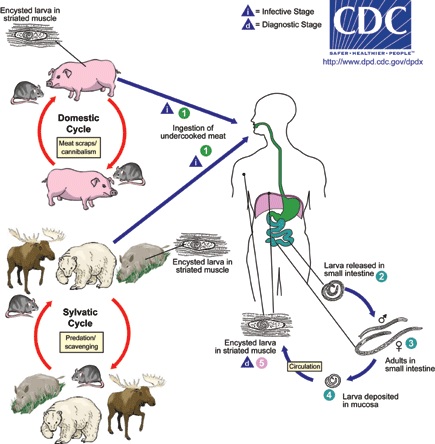
This parasite has an interesting life cycle. It begins with an uninfected animal eating an infected animal.  This can happen amongst domestic animals such as pigs or amongst wild animals living in various environments. Epidemiologist W. C. Campbell constructed four life cycles based on the involved hosts of this parasite. The first was the domestic cycle, which involved pigs and is the most important cycle that involved accidental human infection. The other three may be due to other species of Trichinella and may also involve accidental human infection, but is far less common than the first cycle. These three cycles are known as sylvatic cycles and involve different animals for different climatic regions. To keep things simple, we will only talk about the domestic cycle today.


Cross section of muscle tissue containing nurse cells.
For the domestic cycle to complete itself, a human has to eat some infected pork that has not been cooked well enough to kill off the parasite. Once inside the human body, the parasite larvae are released from their cysts that were formed in the pig's muscle tissue. The larvae mature into adults in the small intestines and search for mates. When a male and a female find one another, they mate and produce offspring that are deposited in the mucosa. The larvae migrate out of the mucosa and follow bloodstreams until they find a nice, quite piece of skeletal muscle to call home.  The larvae encyst in the muscle tissue and form what are called "nurse cells".  These "nurse cells" actually manipulated the surrounding tissues into bringing it nutrients rather than sounding the alarms and bringing in a brigade of immune cells to fight off the invading parasite.  Inside its cozy little nurse cell, the parasite lives awaiting the day that the human will die and be eaten by another suitable host in order to complete its own life cycle.  Little does it know that humans are more often dead-end hosts for these little guys.

Nurse cells that formed in a pig's diaphragm.
The nurse cells begin by instigating new blood vessel formation. The environment inside muscles is hypoxic, meaning that it lacks an adequate amount of oxygen. This environment stimulates other muscle cells to start secreting angiogenic cytokines, which form the new blood vessels that surround the single muscle cell into which the larva will penetrate. The cell continues to pump out the cytokines at the parasite's demand and the cell maintains a constant state of hypoxia. Some research has shown that these cytokines may also lead to an increase in collagen production, further protecting the cell.

Within pigs, this parasite is transmitted by pigs eating infected meat scraps from other animals or from their common practice of cannibalism. (Trust me, I grew up on a pig farm...YES Wilbur will eat his babies if their mother accidentally lays on them, suffocating one while nursing three. They are stupid, dirty creatures, and they deserve to be eaten. Plus, bacon is delicious!)

Trichinosis
 After becoming infected, a person may start having symptoms in as little as 12 hours or as much as 2 days. As the worms move through the body, they damage parts of the intestine and cause immune responses that result in inflammation.  Such responses can manifest as nausea, vomiting, sweating, and diarrhea. 5-7 days later, some people experience fevers or facial swelling (a.k.a. "facial edema"). After 10 days, people will experience intense muscular pain, difficulty breathing, low blood pressure, and possible nervous disorders.  The disease can cause severe damage to the heart, respiratory issues, or kidney malfunction that can eventually lead to death.

An artist's depiction of a
larva in a nurse cell.

In pigs, the symptoms are often undetectable unless the parasite load is so much that it can cause fatality (uncommon).

Diagnosis, Prevention, and Treatment

For a muscle biopsy, you have to make
an incision in the skin to reveal the
underlying muscle, then a hollow
needle is used to extract a small
amount of muscle tissue for
laboratory analysis.
For humans, Trichinosis is often misdiagnosed as flu due to the similarity of symptoms. To confirm a suspected case of trichonosis, a  doctor may order a muscle biopsy (which is invasive and rather painful from what I hear) or a seriological test.

Pigs are diagnosed following ELISA testing.

To prevent the transmission of this disease, the US has a national surveillance system that tracks reported cases and inspects sources of possible contamination. The pork industry has also made changes in order to reduce pig exposure to this disease and to recognize warning signs of infection in order to treat pigs before being slaughtered for their meat. Laws have also reduced risk of human infection by regulating pork processing procedures, such as providing guidelines for specific cooking and freezing temperatures and times as well as for curing procedures.

I like this picture of the medicine because
it looks like a worm was drawn on one
side of this pill! :p
The best way for you to ensure your own safety is to cook pork using hot enough temperatures for long enough to kill off any potential parasites. Or if you are really paranoid, you could freeze the meat for awhile first, and then cook the hell out of it. (No one likes a rare pork chop anyway, right?!

To treat trichinosis, humans and pigs are both prescribed antihelminthic drugs such as mebendazole or albendazole. In humans, this is not always affective. Humans also receive corticosteroids and painkillers to cope with the pain of the infection as it is being treated.


Moral of the Story
Mmmm...Teriyaki pork loin!
Is it cooked all the way through?...
The moral of the story today is to follow good food safety guidelines when preparing pork. (Or bear, or rats if you are into that sort of thing.) It is less important in this country than it would be in countries with less regulation in the pork industry, but it's still always a good idea to make sure you cook your pork all the way through. Trichinella spiralis is only one of many parasites that you can contract from eating undercooked pork. Just do yourself a favor and make sure there's not any pink left by the time you are ready to chow down on some teriyaki pork loin or mojito lime pork chops. (Don't judge, both of those are delicious!)


Because I can't NOT post a picture of a parasite colored in rainbow...